The Right to Be Heard — Even From Outside the Kitchen Window?
Shalzed investigates a new law criminalizing protest outside homes
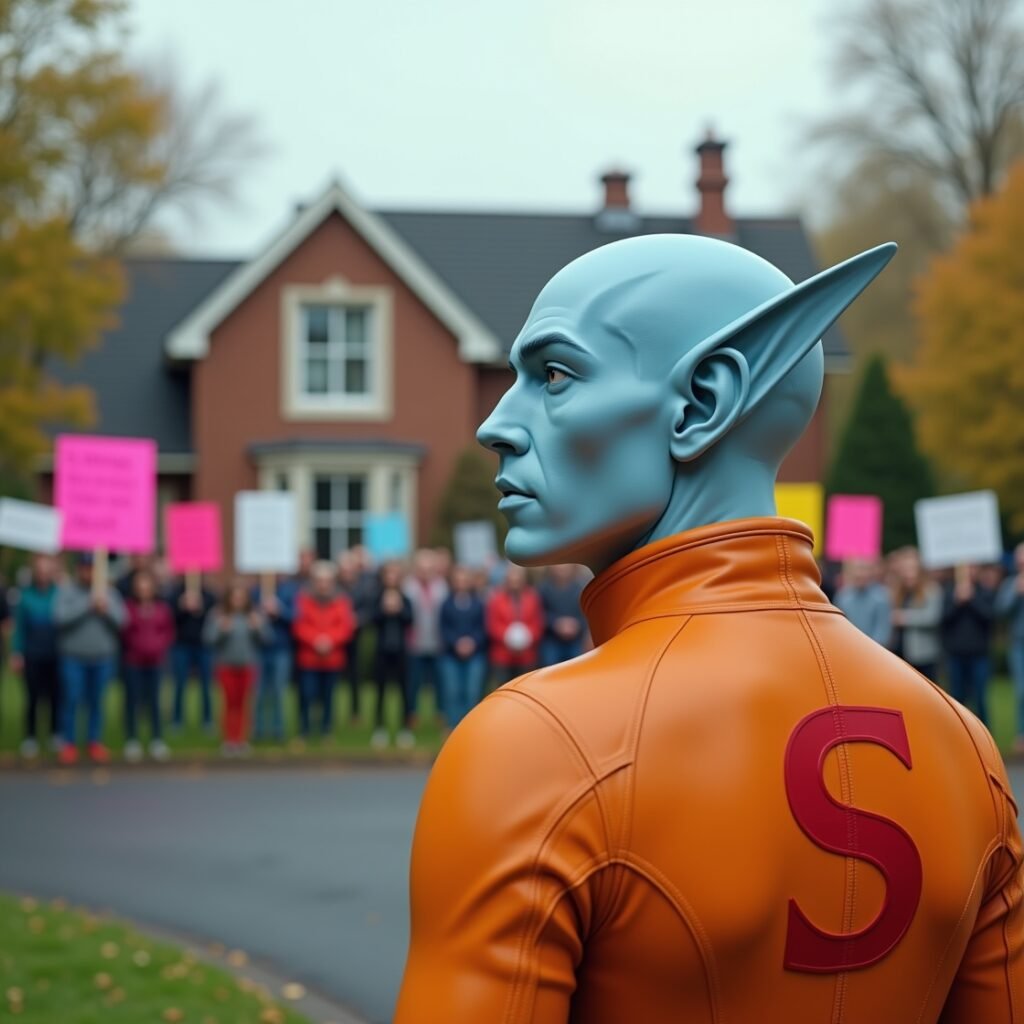
On Aug. 15th New Zealand’s Justice Minister Paul Goldsmith introduced a law making it a crime to protest outside a home. Shalzed visits Auckland to find out whether this is respect for people’s right to privacy, or a step towards taking away the freedom to demonstrate and express political opinions.
I felt a little out of place hanging around in front of Paul Goldsmith’s house. A few cars slowed as they drove by, trying to figure out whether I belonged in their neighborhood or maybe just curious about my pale blue skin. And I have to admit, here on Earth I do stand out. I wondered if any of them might call the police.
I thought of taking a seat in the rocking chair on the porch. It would be more comfortable, and I’d also be less visible from the street. But that would be trespassing- not a good idea for a law-abiding, rights-respecting citizen like me.
A black sedan with tinted windows finally pulled into the driveway. Goldsmith lived in an older house with a detached garage, meaning that after parking his car he would have to come back out. He noticed me as he pushed the garage door button. “Shalzed?” he called. “What are you doing in New Zealand?”
“Since I’m from the other side of the galaxy, a little more travel isn’t a problem,” I told him. Of course I came to Earth in a wormhole, which takes absolutely no time to cross. Primitive airplanes are nowhere near as convenient.
“So what do you want?” Goldsmith slung his briefcase on top of a green plastic recycling bin and put his hands on his hips.
“To protest,” I told him.
He gave me a funny look. “For what, the farmers?”
“No, I just want to be able to protest,” I told him. “Before your new law takes effect.”
Goldsmith waved his hand. “Give me a break. It only forbids protests outside of people’s homes. If people want to make a public statement they can go to the park. They can march down the street. What’s the problem?”
I didn’t come all the way to Auckland just to listen to that sort of B.S.. “Really? And how long will it be now until you make a law against protests in the parks also? Don’t joggers deserve not to be disturbed too?”
“That’s absurd. The only point is that people have a right to privacy in their own homes. How would you like to have dozens of people right outside your door waving signs and chanting slogans each evening?”
“Well the whole point of a protest is to draw attention,” I told him. “Protesting is worthless if you can only do it at a faraway place no one sees.”
A woman wearing a red apron with a picture of a kiwiburger stepped out of the house. Probably Melissa, Paul Goldsmith’s wife. “If you want to talk to my husband you need to make an appointment to see him at his office. Now it’s dinner time,” she scolded me.
“Actually, I’m starting a protest,” I replied.
She groaned. “It’ll just be a minute, sweetheart,” Goldsmith told her. Then he turned back to me. “Protests outside of politicians’ homes aren’t fair to the neighbors. What did they do to deserve it? And what about the family? Why should kids have to see people calling calling their mom or dad names every time they leave for school in the morning? It’s not right, that’s all.”
“Sure, sure,” I told him. “And also Premier House. Probably no protests there either because the Prime Minister might have innocent little children.”
Goldsmith looked unsure. “Doesn’t the law apply there also?” I asked him. “After all, the Prime Minister’s official residence is a house.”
“There’s nothing unusual about this new law,” Melissa chimed in from the doorway. “In the United States they don’t allow protests outside of people’s homes either.”
That wasn’t really true- it depends which state or even which city. But she was right that the U.S. Supreme Court has ruled that restrictions on protests outside of private homes are legal as long as protestors can still march through residential areas and spread material door to door.
“You know that this is only going to be enforced selectively,” I told Goldsmith. “Protest at the home of a government minister, the police will come right away. But if it’s a member of the opposition, or someone the government doesn’t like? Then what?” I asked.
“Speaking of the police,” Melissa said.
I turned and saw a squad car pulling into the driveway. “We got a call about a suspicious individual standing in front of your house,” an officer said to Goldsmith as he got out. He started looking me over.
“Just here to protest the law against protests,” I said, hoping a little silliness would set them at ease.
“He’s harmless,” Goldsmith told them.
Harmless? Hardly the way to talk to about someone who designed a system of super reflective mirrors that focus a full 50% of a star’s energy output onto a single point, causing it to reach 15,000 degrees. It provides enough energy to hold open a wormhole. But why argue?
“We’ll escort him away,” the officer said. Some neighbors, attracted by the police car, came out on their lawns to see what was going on.
“You see how much of a disturbance just you are causing right now on your own?” Goldsmith said to me. “Imagine if there were protests here each evening. Noise, traffic, it’s not fair to everyone who lives in the neighborhood.”
The policeman started stepping towards me, giving me his menacing look. “Hey, I’m a tourist,” I said to him. “I’m just on my way to Sky Tower. Buddy, relax.”
“Well Sky Tower closes at eight, so you’d better get going,” he said, snapping the back of his right hand against his other palm.
I turned to Goldsmith. “You know noise and street blockages aren’t valid reasons to ban protests,” I told him. “There are already separate rules for that. You’re just trying to sweep protestors away where you don’t have to see them.”
“I made roasted lamb for dinner and it’s getting cold,” Mellissa said, pointing her husband towards the door. “You have to come now.”
Goldsmith took his briefcase and went inside without giving me another look. The officer remained facing me with his arms crossed.
“I’ll be on my way,” I told the policeman.
“I don’t see any reason to take you in,” he said. “But give me one, and it’ll be my pleasure to do it.”
“Have a good evening,” I told him, then I started walking towards the main road. A few minutes later the squad car drove by, and the officer gave me a long glance. If he followed me he would find out I had been lying. I wasn’t going to Sky Tower- a chance to look around from atop a pile of concrete a few hundred meters high didn’t exactly excite me. But I did want to check out Auckland’s aquarium- on my planet we have very small oceans, so I find the variety of sea life on Earth fascinating. I’ve never seen anything like an anemone or clown fish before.
I imagine Goldsmith means well with his law against protests. But there’s a saying Earthlings attribute to John F. Kennedy that comes to my mind: Those who make peaceful revolution impossible will make violent revolution inevitable. As long as protestors are peaceful and follow rules about not impeding access to private property or causing other undue disturbance, trying to shoo them away seems like a bad move.
Questions:
- Does a prohibition on protests outside homes, while still allowing protestors to march through residential areas or distribute literature door to door, properly balance residents’ right to privacy against the public’s right to protest?
- Does a prohibition on protests outside of homes represent the start of a slippery slope towards eroding the public’s right to protest? For example, could this law also be used to forbid protests outside of a governor’s mansion or other official residence? Will it begin a movement towards future laws that prohibit protest in other sorts of places?
One story or question each Friday in your inbox
Glad You're On Board
You'll receive an email each Friday, one week a story, a question the next.
All of Shalzed's emails are sent via Substack.