How Shalzed and Simon First Met
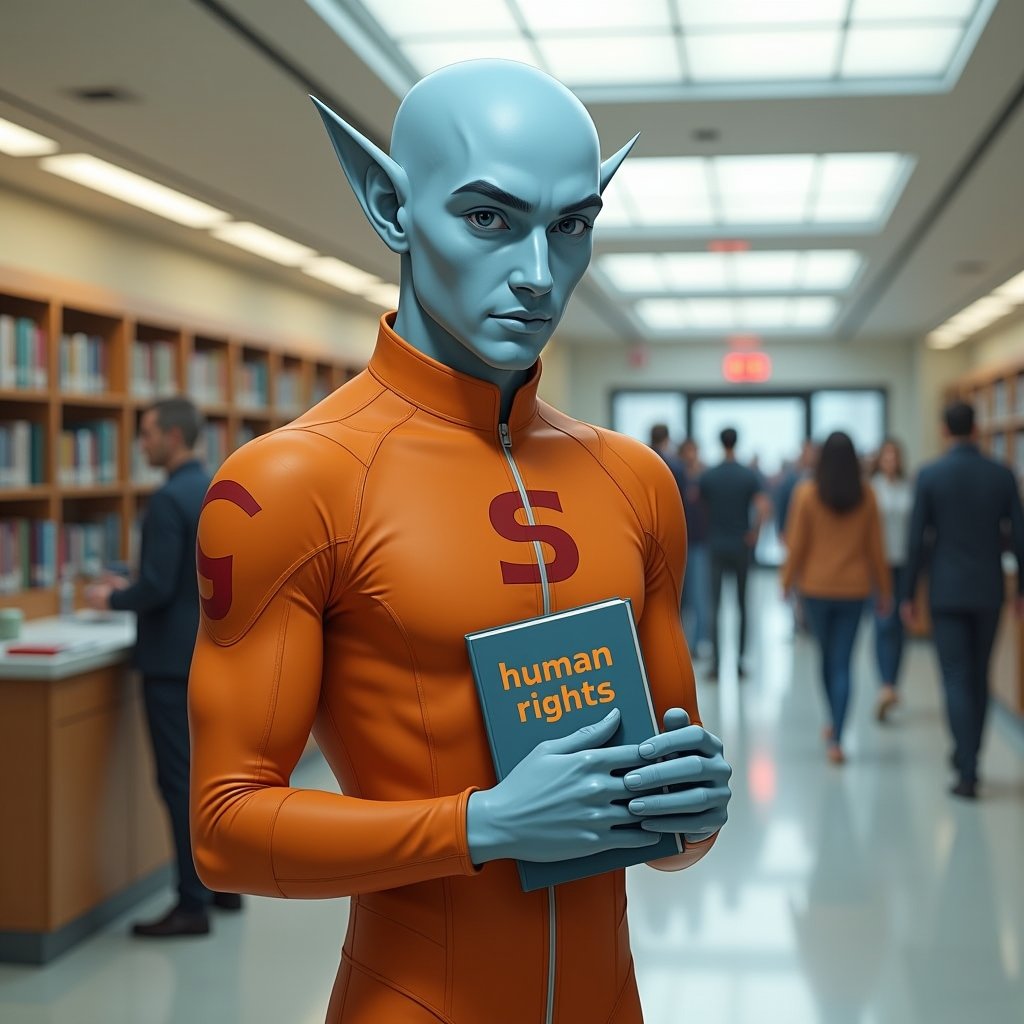
It all began at the library. Dina Perlstein, whose son Aaron is in my eighth grade Mishnah class, spotted me just as I finished checking out a new Grisham novel on the self-checkout machine. “Moreh Simon,” she said as she hurried over. “I have to talk to you about the test you gave last week.”
It always embarrassed me to be called ‘moreh’ outside of school. “Nice to see you,” I said, glancing towards the door. Since she was Orthodox I didn’t offer to shake her hand. “I just finished grading, tomorrow I’ll give the tests back to the class.”
“Did Aaron do alright?”
Why do parents think I know every kid’s grade by heart? “I think so,” I told her. “I don’t recall off the top of my head.”
“Remember he was very busy the night before the test preparing for his bar-mitzvah. I’m sure you agree that has to take precedence.”
Just then the red flashing light went on at the library exit and the gate made an alarm sound. We both turned to look. A man with pale blue skin and pointy ears was stuck at the locked turnstyle, looking bewildered.
“Did you forget to check out that book?” the librarian called from behind the desk.
The man frowned. “Check out?” he asked.
The librarian looked annoyed. “That book you’re holding, did you check it out?”
The man scratched his chin. “Why did this electronic apparatus suddenly begin emitting photons of approximately a 700 nanometer wavelength and causing atmospheric oscillations of such an unpleasant type?” he asked.
The librarian stared, but I laughed. I decided to walk over. This man seemed to need a little help, and it was a good excuse to get away from Mrs. Perlstein. “Have you used the library before?” I asked him, extending my hand. He shook his head. I noticed that the title of the book he was holding- An Illustrated Guide to the Universal Declaration of Human Rights.
A woman pushing a stroller came behind us, so I nudged him out of the way, back towards an unoccupied table at the edge of the lobby. “No,” he said simply.
“Do you have a card?” I asked.
He opened the book and turned to a page which he found quickly from memory. “Everyone has the right to receive and impart information and ideas through any media,” he quoted. “So I must be allowed to take this book.”
I chuckled. “Listen, to borrow a book from the library you need a card.” He narrowed his eyes and looked around the library like he was afraid the walls would start closing in and he had been lured into some sort of trap. “Do you live around here?” I asked.
He hesitated, then shook his head. Then he told me a story so incredible that at the time I thought he was crazy, but by now I’ve personally verified at least most of it, and so I know that it’s true.
He said that he is from a troubled civilization about ten light years away. Their species has divided into hundreds of warring tribes. They kill each another, constantly inventing ever more powerful weapons, and they have already destroyed countless moons, asteroids, and even planets as their wars spread throughout their solar system. In each of their tribes a few rich leaders oppress the poor. The masses live in miserable squalor, as the rich keep them divided and weak due to perpetual fear of rebellion.
He had been observing Earth closely. He determined that we have intelligent life based on the light and radio signals we are emitting. He also observed that our atmosphere is clean, water is flowing, and life is everywhere abundant.
So he came to Earth to find out how we do it. He wanted to know how we built the peaceful, utopian society that he believed we had.
When he first arrived, he asked every human he encountered to tell him how our society works. I can only imagine the jokes and chuckles that must have earned him. Then finally, someone sent him to the library, where a librarian gave him the book about human rights he now has in his hands.
“Earth is far from perfect,” I told him. “We have wars, injustice, and oppression too.”
He took a sharp breath and stared down at the floor. “But it says here. . .” he began, pointing to the book.
“That’s in theory,” I told him. “It’s different in practice.”
He raised his head and stared at me. “But why?” he asked.
I shrugged. “I don’t know, it just is. It’s hard to make everyone respect other people’s rights.” The truth is I had never really given it much thought.
I noticed a thick, bluish liquid on his cheek, and had the sense he was starting to cry. He told me that he had been planning to return right back to his planet with the book he was holding, but he wouldn’t do so if human rights didn’t really work.
We talked for quite a while. In the end we agreed that I would help him understand why human rights are so complicated and difficult, so he could decide what report to bring back. I also agreed to let him take the book out on my card. I’m not sure if he realizes he’s supposed to return it in three weeks, but even if he doesn’t everything I’ve learned with him so far has made it worthwhile.
Before we parted that first time I asked his name. The first syllable sounded like a ‘w’ followed by a bleating goat, and it ended with what seemed to me like a combination of a sneeze and a hiccup. There was no way I would be able to pronounce anything from his native tongue. So I decided to call him Shalzed. I got that by combining the Hebrew words ‘shalom’, which means peace, and ‘tzedek’, which means justice. This is what he came to Earth searching for, so I figured it’s fitting.
One story or question each Friday in your inbox
Glad You're On Board
You'll receive an email each Friday, one week a story, a question the next.
All of Shalzed's emails are sent via Substack.