Death Penalty Only for Palestinians?
Shalzed Confronts Ben-Gvir Outside the Knesset
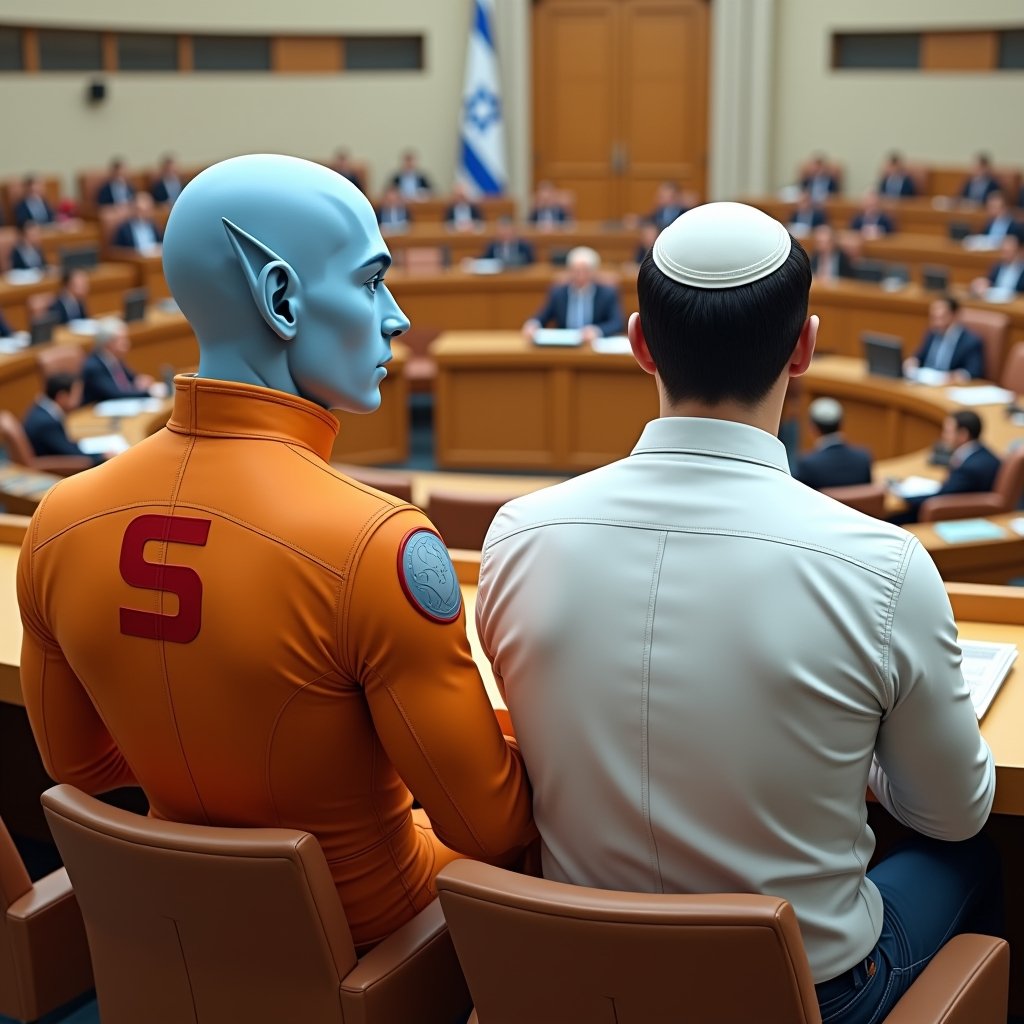
This week Shalzed and Simon head to Jeruslaem. Shalzed wants to understand why Israel is considering a law which punishes those who attack Israelis differently than those who attack Palestinians- a seemingly clear violation of the principle of equality before the law which is fundamental to human rights.
Death Penalty Only for Palestinians? Shalzed Confronts Ben-Gvir Outside the Knesset
First period I teach seventh grade Chumash, then I have a period free. Unfortunately, an older woman named Rosalie Steinburger who has been teaching second grade for over 40 years, is off that period too while her class has either music or gym. Every time she sees me she asks when I’m going to get married and whether I’d be interested in meeting her niece. But this time, to my surprise, it wasn’t Rosalie but rather Shalzed waiting for me in the teacher’s lounge.
“I don’t understand,” he said as soon as I came through the door.
Crazy as it seems, talking to a blue-skinned alien with pointy ears was becoming normal for me, but I wondered how Rosalie, or any of the other teachers, would react if they walked in. “Don’t understand what?” I asked him. “And how did you get into the school?”
“In Israel, a law imposing the death penalty only on terrorists who kill Israeli citizens just passed a Knesset committee, while specifically exempting those who kill Palestinians or others. It impinges on due process and takes away the right to seek clemency. This law is obviously discriminatory and violates human rights.”
“It’s because Israel is tired of terrorists being exchanged for hostages,” I told him.
I heard what sounded like Rosalie’s gentle footsteps in the hall. “You know this is the teacher’s lounge, don’t you? Anyone can come in?”
Shalzed shrugged. I guess he wasn’t worried about having to answer questions. I wondered if maybe I was becoming a little bit possessive towards him. Was I concerned Shalzed might develop other friends on Earth besides just me? “How can Israel even consider such a law?” he asked, ignoring me. “Who would propose such a thing?”
“It’s Itamar Ben-Gvir.” I told him. “He’s from the far right.”
Just as Rosalie started to open the door, I felt myself floating in the dark corridor with little points of light that I was starting to get used to. A moment later Shalzed and I were outside the Knesset, where Ben Gvir was walking towards a waiting black SUV.
“Slicha,” Shalzed called. I wondered if that was the only word he knew or if he could actually speak Hebrew. Or maybe he had a way of learning any Earth language? “Don’t you know that Article 7 of the Universal Declaration of Human Rights says that everyone is entitled to equal protection under the law? So how can you propose a bill that creates one punishment for Palestinian terrorists but a different one for everyone else?”
Ben Gvir stopped and put his hands on his hips. “Palestinians also want to be treated differently than Israelis,” he said. “Didn’t you see them cheering when we released convicted killers in exchange for our hostages as part of the ceasefire? They want Israelis who attack them to be punished severely, while we let their terrorists go.”
I noticed Ben Gvir had a small pin shaped like a noose on his lapel. I’d already seen countless photos of that on Facebook. “Why do you have to wear that?” I asked him. “Don’t you understand the harm you are causing? It makes it look like Israel doesn’t care about international law and is out to kill Palestinians.”
“I don’t care what antisemites think,” he said.
Shalzed crossed his arms. “You can hardly call people who oppose having capital punishment for Palestinians but not for Jews antisemites,” he said.
“If they hold Israel to one standard and the rest of the world to another, then they’re antisemites,” Ben-Gvir replied. “As soon as the ceasefire went into effect, Hamas started rounding people up, and without any due process had then blindfolded and shot them in the head. They called that a security operation. And those same people who said nothing about that are now all up in arms when Israel wants to impose the death penalty to help keep our citizens safe from terrorists?”
“Two wrongs don’t make a right,” I told him.
“There’s a Palestinian so-called human rights organization named Addameer,” Ben-Gvir continued. “They are all outraged by violence against Palestinians in the West Bank, claiming Israel is violating international law by not punishing those responsible more harshly. But at the same time they say Palestinians who have killed Israelis are political prisoners who should be released.”
“Why would a human rights group want convicted terrorists released?” Shalzed asked. I couldn’t help but chuckle at his surprise.
“There’s more,” Ben-Gvir continued. “There’s a 17 year old Palestinian named Mohammad Natsheh that we arrested for throwing Molotov cocktails. They say that because he’s under 18, he’s a child who should be released back home to his parents. But many of the settlers that have carried out arson attacks in the West Bank are also teenagers. Those they want in prison.”
“Itamar,” a woman wearing a businesslike skirt and blouse called as she walked towards us from the Knesset.
“I’ve heard enough from you already,” Ben-Gvir said.
When she got closer I saw from the woman’s ID badge that she was a government legal advisor. “I’m telling you again. Even if the law passes, it won’t take effect. It’s too vague, takes away judges’ discretion, and violates international treaties.”
Ben-Gvir waved his hand. “What’s important is to protect Israeli citizens from terrorists, not to follow treaties the world uses to condemn us while Hamas and all the other countries break them all the time.”
“There are lots of verses in the Torah that say there should be only one law, both for Israel and for foreigners that dwell in our midst,” I told Ben-Gvir.
“Did you tell that verse about one law to the hundreds of celebrities demanding that we free Barghouti? And the ones organizing the free Barghouti campaign?” Ben-Gvir asked.
“What does it have to do with Barghouti?” Shalzed responded.
“On the freemarwan.org website they claim Barghouti has been imprisoned unjustly because he was convicted by an Israeli court he does not recognize. You see, they don’t want equality. They want Palestinian terrorists to go free, while at the same time complaining we don’t punish Israeli citizens who attack Palestinians harshly enough.”
“Why is he in prison?” Shalzed asked.
“Because he helped orchestrate the murder of a group of innocent Israelis while they were just sitting eating at a restaurant,” Ben Gvir replied. “Imagine the world-wide calls for justice should an IDF soldier or Israeli citizen do that.”
“Do you want me to help you fine tune the language?” the legal advisor offered.
Ben-Gvir looked hesitant. “How?” he asked.
“Here is one example. The draft you submitted applies the death penalty only when the victim is an Israeli citizen,” she said. “That means it won’t apply to attacks on permanent residents or tourists.”
Ben-Gvir smiled. “That’s a good point. Let’s go.” He motioned to his driver to wait. “We can talk in my office.”
“This law is going to be used against Israel abroad,” I said. “It will make Israel be seen as racist.”
Ben-Gvir scoffed. “There will always be people who hate us,” he said. “Jews have been persecuted for thousands of years. What matters is that Israel defends its citizens.” He and the woman started walking back towards the Knesset building, as Ben-Gvir asked what alternate phrasings she recommends.
Shalzed looked at me. “I thought on Earth countries would compete to uphold human rights,” he said. “Not violate each other’s rights, then use each violation by the other as a justification to violate rights even more.”
All of a sudden I thought about third period. How long had we been gone? I had no idea how much time elapsed while we traveled. “I’m supposed to be teaching. . . “ I began.
Once more I was in the blackness, and then after what seemed like less than a minute I was back in the teacher’s lounge, in exactly the same spot as before I left. Rosalie Steinburger was pouring herself a cup of coffee by the sink.
“Is that Simon?” Rosalie Steinburger asked, speaking with her back to me. I looked around, but Shalzed wasn’t here.
“Yup, it’s me,” I said, trying to sound cheerful. I tried to think of an explanation if she asked me how I had just appeared.
She turned around, coffee cup in hand, and smiled. “This coming Friday night my niece Sarah will be at my house for Shabbat dinner,” she said. “Sarah is a lovely young woman, she’s about to be licensed as a speech therapist and is ready for her life to get going. Would you like to come over too?”
I swallowed, trying to think of an excuse. “I’m sorry, I can’t,” I told her. “I have a friend visiting from very, very far away. I promised him I’d be free.”
Rosalie Steinburger looked disappointed. “Maybe another time then,” she said as the school bell rang.
“Sure,” I told her. “I’m sorry, but something came up during second period and I wasn’t able to get much done. I have to run and make some copies before my next class,” I said as I slipped out the door.
Subscribe to Receive Shalzed's adventures in your inbox
One story or question each Friday in your inbox
Glad You're On Board
You'll receive an email each Friday, one week a story, a question the next.
All of Shalzed's emails are sent via Substack.