Israel, Somaliland, and the Flexible Definition of a State
A visit to the UN Security Council, where principles stretch under pressure
Somaliland has its own political system, currency, and police force — and has been separate from Somalia for over thirty years.
Last week, when Israel extended official recognition, critics cried “meddling.” Supporters say recognition reflects reality on the ground.
But what’s the difference between that and Palestine?
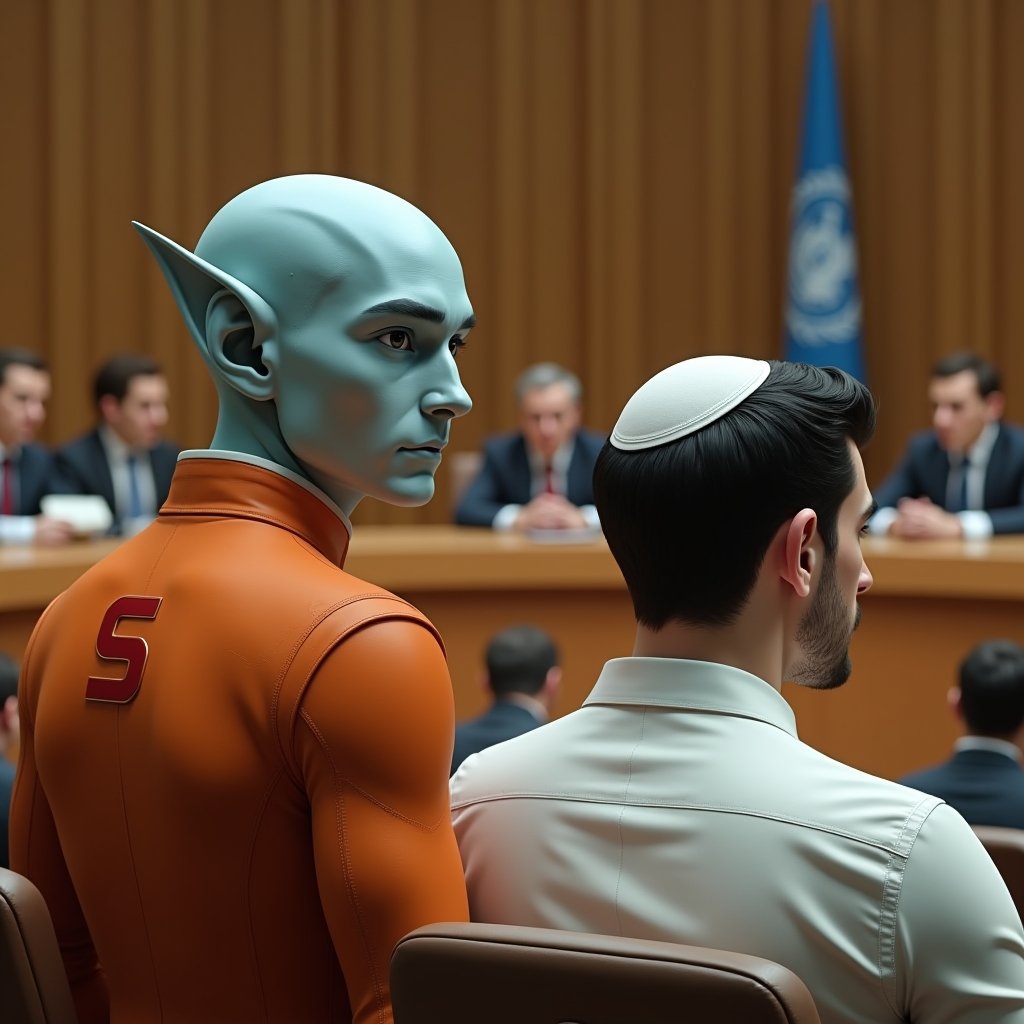
Shalzed and Simon attend an emergency meeting of the UN Security Council to watch diplomats bend their principles when self-interest is at stake.
Israel, Somaliland, and the Flexible Definition of a State
I was on my way home from school, about to head into Stop’n Shop to buy something to make for dinner, when Shalzed called. “Why does the United Nations Security Council think recognizing Somaliland is a threat to peace and security? They are even having a special session about it.”
“About what?” I asked.
“Somaliland,” Shalzed repeated.
I had never heard of it. “What’s that?” I asked.
“Somaliland has been independent from Somalia for over 30 years. It has its own elections, government, currency and police,” he said. “Now Israel was the first country to recognize it as a state.”
I had no idea why that was important, but before I could say anything I was whisked into the dark tunnel that by now seemed second nature. A moment later I was seated next to Shalzed in the UN Security Council visitor’s gallery in New York.
“I don’t see the problem, let alone a threat to security,” Shalzed said to me, as if instantaneous travel across long distances was no big deal. “If the people living in Somaliland want to be independent, isn’t it their right?”
“How did you get us in here?” I asked.
Shalzed turned towards the podium, as he always refuses to answer that question. The French delegate was announcing that her country opposed Israel’s decision. “Internal disputes within Somalia must be resolved in a negotiated manner,” she said.
“But if the people in Somaliland believe that they can achieve better freedom or more stability from being separate, shouldn’t that be their right?” Shalzed asked me again. “Why should Somalia have a veto?”
I shrugged. “I guess they don’t want every group to secede and start their own country,” I told him. I made a point of whispering, hoping he would also keep his voice down.
When the French delegate finished, the U.S. representative took the floor. She said Israel has the right to conduct its own diplomatic relations. Then she added that just a few months ago several countries unilaterally recognized a Palestinian state, and there was no emergency meeting called to express outrage about that.
“That’s a good point,” I said quietly to Shalzed. “Isn’t that exactly what Israel and the U.S. say about Palestine, that statehood should only come about via negotiation?”
Shalzed frowned. “There must be some difference,” he said.
The observer from the African Union was next. He said recognition of Somaliland is an attempt to undermine Somalia’s unity, sovereignty and territorial integrity, and is against international law. Then he added that the UN Charter requires the full recognition of Palestinians’ legitimate right to establish an independent state.
Shalzed shook his head. “I don’t understand,” he said to me. I gestured for him to whisper, but he seemed too upset. “If it’s against international law to recognize Somaliland’s independence without Somalia’s agreement, then how can countries recognize Palestine even though Israel is opposed? And if Israel says no countries should recognize Palestine without its consent via negotiations, why is it going ahead and recognizing Somaliland as an independent state?”
An African man wearing a bright red shirt with purple stripes sitting in the row behind us tapped Shalzed on the shoulder. “Just another day at the United Nations,” he said. “Now can you please be quiet?”
Shalzed glared at him, then turned back to the proceedings. The representatives took turns talking, saying pretty much the same things. When it was over Shalzed jumped to his feet. “I have some questions,” he said. He headed towards the exit, pushing people out of his way so aggressively many stopped to stare. I apologized on Shalzed’s behalf as I tried to follow, mumbling that Shalzed ‘was not from here’.
When I finally reached the hallway Shalzed was already in the middle of the foyer, talking to a man I recognized as Danny Danon, Israel’s Ambassador. I did my best to avoid colliding with diplomats leaving the Security Council chamber as I headed over.
“Somaliland has a permanent population, independent government, defined territory, and capacity to conduct international relations,” Danon was saying. “So according to the Montevideo Convention, it meets all the criteria for statehood. Palestine doesn’t have a government, since it’s split between Hamas and the Palestinian Authority, and neither has had free and fair elections for ages. And Palestine doesn’t have a defined territory because its borders aren’t resolved.”
The French representative had been walking by, but she paused and turned towards Danon. “That’s absurd,” she said in a thick French accent. “The Palestinian Authority is recognized internationally as a legitimate government. The fact that exact borders must still be negotiated doesn’t mean Palestine lacks a defined territory. Somaliland was once a part of Somalia, that’s why it can’t become an independent state unilaterally. But Palestine was never part of Israel, it’s occupied.”
Shalzed looked confused. “I have a tv interview waiting,” Danon said, starting to go.
“If it’s not too much to ask, I’d like a word with you first,” the French Ambassador told him.
“About what?” Danon asked with a frown.
The French ambassador gestured towards Shalzed and me. “I’ll be happy to tell you in just a moment.”
“If you’re so certain that Somaliland should be independent, why did it take you thirty years?” Shalzed asked Danon. I wondered if he was oblivious to the fact they wanted us to leave, or just didn’t care.
Danon smiled. “Better late than never.”
That was ridiculous. “Israel’s government has been too busy for the last three decades?” I asked him.
Danon clicked his tongue. “Listen,” he said. “No matter the law, states only extend recognition when conditions are right strategically and politically.”
“In other words, right now an alliance with Somaliland serves Israel’s interests,” I said.
Shalzed turned to the French Ambassador. “Do you really believe Palestine has a functioning government, even though Abbas was last elected in 2005, for a term that was supposed to be four years, and he is only in charge of the West Bank while Hamas runs Gaza?” he asked.
“Recognition is necessary to preserve the possibility of a future Palestinian state,” she replied. “Recognizing the Palestinian people’s right to self-determination is the only way towards a future without permanent conflict.”
“But. . .” Shalzed began.
“Excusez-nous,” the French Ambassador said, gesturing us aside.
“L’hitraot,” Danon added. He must have assumed from my kippah that I know at least a little Hebrew.
“You’re both contradicting yourselves,” Shalzed said.
“C’est la vie,” the French ambassador replied, waving her arm. She pulled Danon away, towards a quiet corner. “Au revoir.”
Shalzed stared at them for a moment with his hands on his hips, and a man wearing an ‘S’ badge, meaning that he was a member of the secretariat, bumped into him. “You can’t stand here, right in the middle of the hallway,” he said. Then he looked at us more closely. “What badge do you two have?”
Shalzed looked at me. “Isn’t this all just politics pretending to be about law?” he asked.
The guy from the Secretariat looked at us suspiciously. “If you don’t have badges, I highly suggest you leave,” he said before I could figure out anything to say to Shalzed.
Suddenly I was in the black tunnel with points of light, then a moment later I found myself back in my apartment. I had meant to buy something to cook for dinner at Stop’n Shop, but now if I wanted to do that I’d have to get my bike out or wait for the bus. Then I realized I still had a pizza in the freezer- that would do.
I looked around and Shalzed wasn’t here, and he wasn’t calling me on the phone. I baked the pizza in the oven then watched sports bloopers on YouTube while I ate. In a way I was glad Shalzed let me alone, since I was hungry. But I also worried. He told me he came to Earth because he thought our system of international law and human rights could be the secret to peace not only here but also on his home planet. I felt sort of guilty, like I was letting him down. Now that he sees how easily international law is warped by politics, I wondered if he would even bother to stay.
Subscribe to Receive Shalzed's adventures in your inbox
One story or question each Friday in your inbox
Glad You're On Board
You'll receive an email each Friday, one week a story, a question the next.
All of Shalzed's emails are sent via Substack.
Sources:
Coverage of Israel’s recognition of Somaliland from the BBC
Summary of UN deliberations
Questions:
- Is it hypocritical to recognize Palestine or Somaliland, but not the other? Or are there valid distinctions between the two cases?
- Since every new state necessarily takes territory from an existing one, governments tend to frame secession as an illegal threat to sovereignty, while seceding populations frame it as necessary to fulfill their right of self-determination. Are there any objective criteria that can determine who is right, or does recognition always depend on power and politics?