When the UN Charter Meets Black Ops
Shalzed Confronts Marco Rubio Over the Maduro Abduction
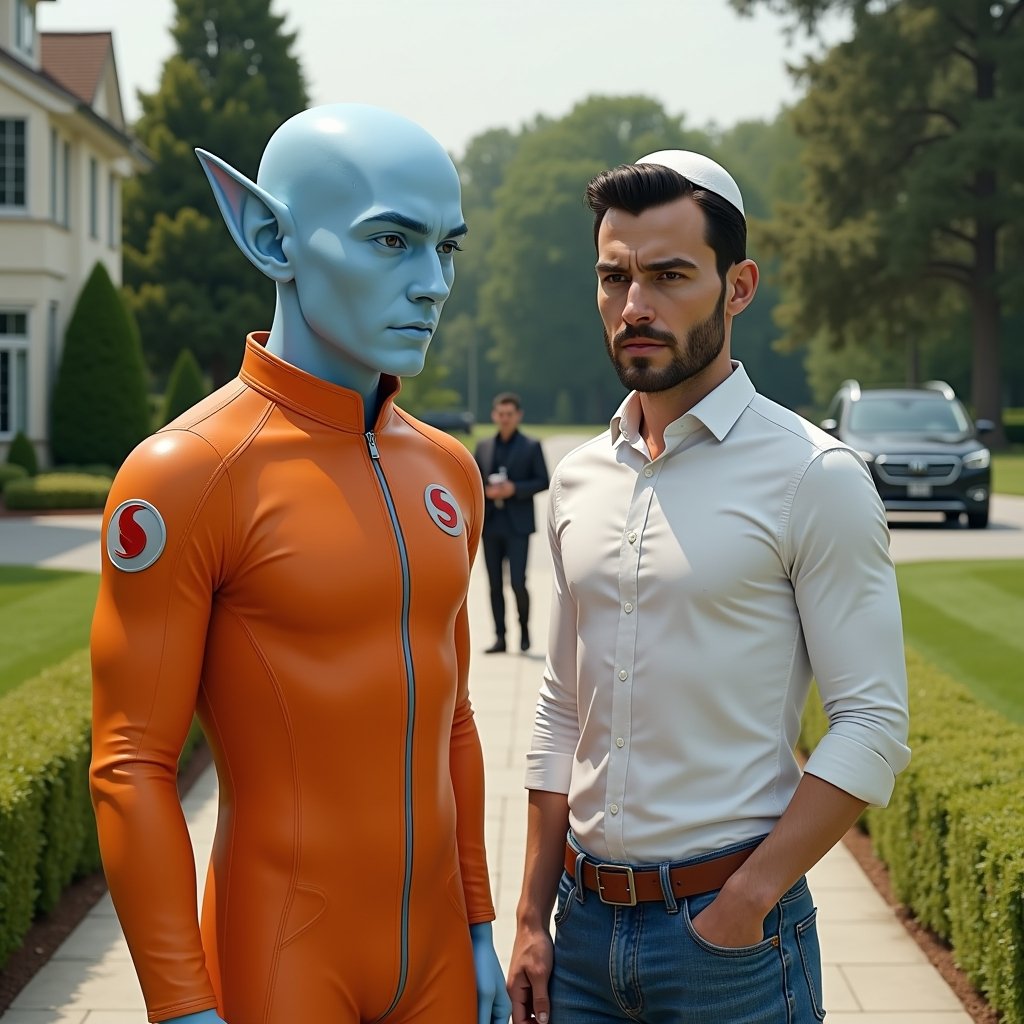
International law says no. Reality is a maybe.
This week, Shalzed and Simon go to Mar-a-Lago to ask Marco Rubio what the rules mean when it comes to Venezuela.
When the UN Charter Meets Black Ops
I usually don’t watch the news, but I was surprised enough by the U.S. abduction of Nicolas Maduro to turn on the television while I made oatmeal and toast for my Sunday morning breakfast. Experts were speculating about what’s next for Venezuela. Then, just as Chuck Schumer was complaining that Trump failed to notify Congress, Shalzed called.
“How can one country send its army to capture the leader of another?” he asked. “Isn’t that against the most fundamental rules of international law?”
That’s pretty much what Schumer was now saying on TV. “The Democrats seem to agree with you,” I said as I turned the volume down.
“Democrats?” Shalzed asked. “But the prohibition on using force is in the charter of your United Nations. What does that have to do with Democrats or Republicans?”
Before I could say anything, I was in the black tunnel I had already grown accustomed to. This time, since by now I was no longer afraid or panicked, I tried to feel around to sense if there were walls or if I was traveling inside of some sort of vessel. I didn’t feel anything, and then a moment later I was outside Trump’s Mar-a-Lago country club in Palm Beach, Florida. Shalzed was next to me. We were standing on a wide sidewalk lined by neatly trimmed hedges with a vast, manicured lawn on either side. Through the palm trees, I could just make out the ocean.
“Mr. Secretary,” Shalzed exclaimed, starting up the path towards the main entrance. Marco Rubio was coming out. He looked tired. He had his suit jacket folded over his arm, with a red tie hanging out of his pants pocket.
“Who are you?” Rubio asked. He looked Shalzed over, then glanced at me as I came up behind.
“Wasn’t sending troops to abduct Maduro a flagrant violation of international law?” Shalzed asked.
Rubio shook his head. “Of course not. It was actually law enforcement. Maduro was indicted for trafficking cocaine, and now he’ll face trial in New York.”
“The U.S. can’t make arrests in other countries,” I said. I may not be a lawyer, but at least I know that much.
“And Maduro has immunity as a head of state,” Shalzed added.
Rubio scoffed. “Maduro was the head of a drug trafficking operation masquerading as a government,” he said. “He rigged the last election to stay in power, so he’s not a legitimate president at all.”
“So the United States gets to decide which governments are legitimate—and send in troops when needed?” Shalzed asked.
Rubio sighed. “It’s been a long night, gentlemen,” he said. “I don’t recall seeing either of you before in the ballroom, are you guests for just a few nights? Or are you here for a round of golf?” He raised his eyebrows. I read somewhere that joining Mar-a-Lago costs $1 million upfront, then $20,000 in dues annually. I was wearing jeans and an old Camp Ramah T-shirt, so I probably didn’t look like I belonged.
“He’s come from very far just to be here,” I said, gesturing to Shalzed. However he got us in, I hoped he would also get us out before we were picked up by the secret service.
“Do you really want to undo the principle that countries have to respect each other’s sovereignty?” Shalzed asked. “Isn’t that the key to peace, and fundamental to the UN Charter?”
Rubio shrugged. “The problem with sovereignty is that it usually winds up being used to protect tyrants and dictators.” He tossed his suit jacket over his shoulder and put his hands on his hips. “Do you realize that nearly 8 million Venezuelans have fled due to Maduro, and about 750,000 of them are in the United States. Biden gave most of them protected status because they face persecution back home. How can the U.S. be obligated to bear all these refugees, but not be allowed to do anything about what’s causing them to seek refuge in the first place?”
“But whatever is to be done has to be decided by the UN Security Council,” Shalzed said. “It can’t be left up to only one country.”
Rubio waved an arm. “That wouldn’t work. Russia and China would use their veto.”
“As if the United States doesn’t use its veto, too,” I added.
I felt a hand on my shoulder and turned to see a man in a dark suit with a listening device in his ear behind me. “Mr. Rubio is a busy man,” he said. “I think he needs to get going.”
“Enjoy the golf course, gentlemen,” Rubio said. “Assuming you’ve actually reserved a tee time.”
Rubio walked around us and headed towards the gate, where a black SUV was waiting.
“What are your names?” the man in the dark suit asked. He took a tablet computer from his jacket pocket and opened a page with a list of registered Mar-a-Lago guests. “And I may need to see some ID.”
“Listen,” I said, trying to think of something to say. I realized that I didn’t even have my wallet, my pockets were empty when Shalzed whisked me away. I turned to Shalzed, who was staring at Rubio as he left.
“Are the two of you not on the guest list?” the man asked, pretending to be surprised.
“Um,” I mumbled, touching Shalzed on the elbow. When he finally turned I gave him a pleading look.
I felt relieved to suddenly be back in the black tunnel. I wondered if Shalzed would still have been able to pull off his transportation trick if the guy had put us in handcuffs. Before I knew it I was in my apartment. I smelled something burning and look at the stove. The oatmeal had been on the fire the whole time. The water had all boiled off, and as I turned off the flame I wondered if the pot was ruined.
Shalzed was with me in the kitchen. “How long were we gone for?” I asked him, pointing to the burned oatmeal. I wondered if this could finally be a way to get some information on how his black tunnel worked.
But instead of answering, Shalzed stared at the television. This Week With George Stephanopoulos was still on, and the United Nations High Commissioner for Human Rights was explaining that even though Maduro had a longstanding, appalling record on human rights, that was no reason to justify U.S. intervention in Venezuela.
“But Maduro has been in power for over a decade,” Shalzed said. “And the Human Rights Council never did anything about it.”
“It does seem strange to see the High Commissioner for Human Rights arguing that Maduro should still be in power,” I added.
I wondered if Shalzed was hungry. “I’m going to make some more oatmeal,” I told him. “Would you like some?”
He looked at the burned pot. “Why?” he asked.
I smiled, thinking maybe this was my chance. “Because that pot was on the stove when you took us to Mar-a-Lago. Since we were there for only about seven or eight minutes, that must mean that we spent at least three or four minutes in transit each way, or the oatmeal wouldn’t be so burned. Right?” I asked.
“It looks delicious,” he said. He went to the pot and pulled out a few black, dried-out oats. He put them in his mouth and smiled. “It reminds me of the food we serve at festivals.”
“So you transported us from here to Florida in three or four minutes,” I repeated, hoping he would confirm or deny.
But instead, he turned back to the television. It was showing footage of Venezuelan exiles celebrating in Miami. One of them told a reporter that while he was fearful for his family back in Caracas, he was grateful to Trump and hoped this would finally be a chance for Venezuela to experience freedom.
“Is the High Commissioner for Human Rights going to tell them that they’ve got it all backwards?” I wondered out loud.
Shalzed shrugged. “Can I take that with me?” he asked.
“Sure,” I said, handing him the burned pot. I doubted I would be able to clean it anyway.
“Thanks,” he said. “I’m starting to wonder whether Earth’s international law and human rights work as well as I thought. But I’m glad that at least I discovered this delicious food called oatmeal.”
Subscribe to Receive Shalzed's adventures in your inbox
One story or question each Friday in your inbox
Glad You're On Board
You'll receive an email each Friday, one week a story, a question the next.
All of Shalzed's emails are sent via Substack.
Questions:
- The prohibition on the use of force in international relations is a bedrock of peace and stability. However, human rights are also a key value, and oppressive regimes can use the prohibition on force as a shield to protect themselves from consequences. Which value is more important? How do we decide?
- Approximately 8 million Venezuelan citizens have fled their country, seeking refuge from Maduro’s regime. Many have settled in Central or South America, and about 750,000 are in the United States. Does bearing the cost of caring for refugees give states a special right to use force to change the conditions that caused their flight?