Free Speech, With an Exception
Shalzed Visits PEN America
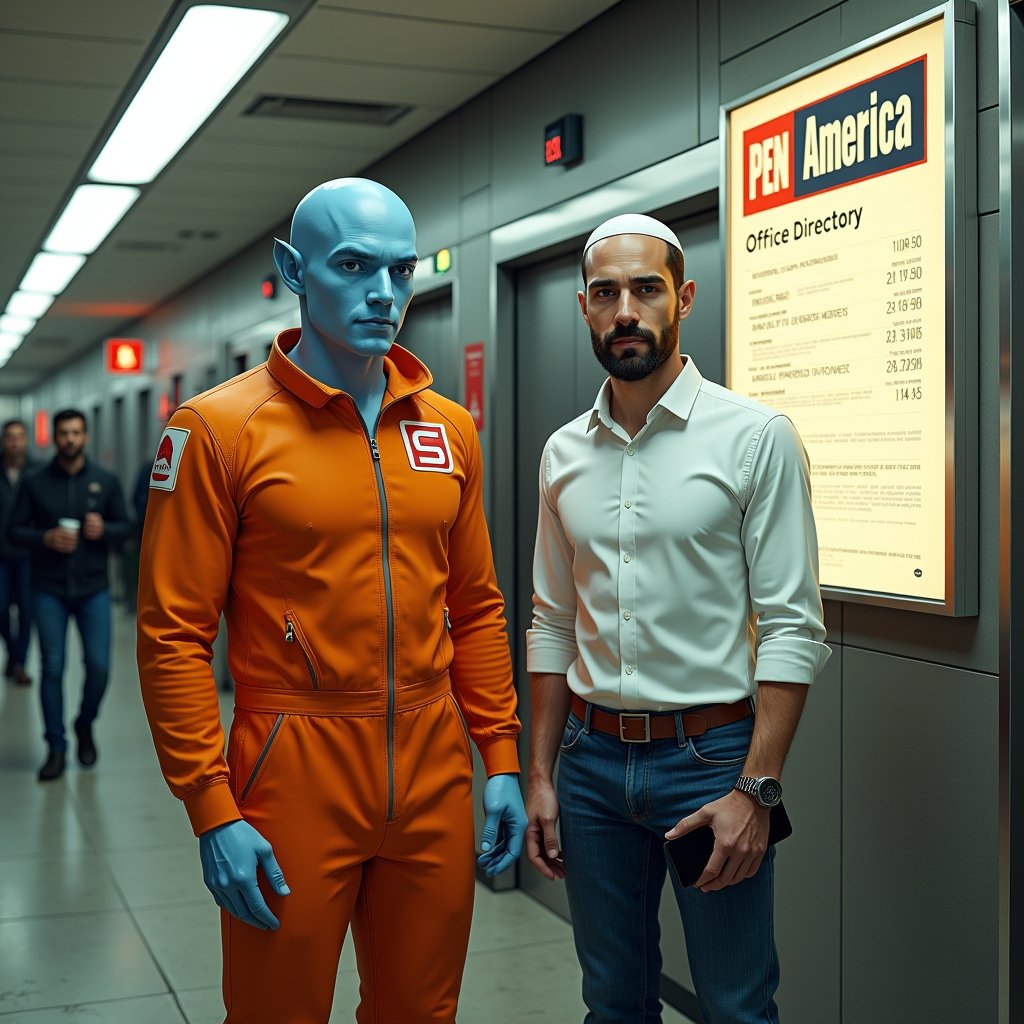
An Israeli comedian was blocked from performing in New York and Los Angeles by a throng of protesters. Sounds like something free speech advocates should be up in arms about, right? This week Shalzed visits the free speech advocacy organization PEN America to find out.
Free Speech, With an Exception
As I locked my bike outside the library, I remembered the time I first met Shalzed. He had been trying to leave with a book without checking out. Then I saw him right on the nearby corner of Main and 3rd Street, walking towards me.
“A comedian wasn’t allowed to perform because of protests,” he said.
I finished scrambling the dials on my lock and stood up to face him. “Let me take a random guess- the comedian was Israeli.”
“How did you know?” Shalzed asked in surprise.
I typed into my phone ‘Israel comedian cancel’ and quickly found the information. “His name is Guy Hochman. They cancelled on him once in New York and once in Los Angeles,” I said. “Because of anti-Israel protests.”
“But doesn’t that violate his freedom of expression?” Shalzed asked.
I noticed a link to a statement from Pen America opposing the cancellations. “Of course it does,” I told Shalzed. “And one of the largest free speech organizations in America says so too.”
Suddenly we were in the black tunnel, and a moment later in the lobby of the Equitable Building in the financial district of Manhattan. I saw right away on the list of tenants that PEN was on the 26th floor.
“Mr. Friedman,” Shalzed called to a bald, middle-aged man wearing a blue suit jacket and slacks, carrying a briefcase and coffee cup as he headed towards the elevator. “Can you explain why an Israeli comedian was not allowed to perform?”
Friedman stopped and sighed. “I understand what you’re referring to, and it’s a very sensitive situation.”
“Why?” Shalzed asked. “Isn’t everyone entitled to freedom of expression?”
Friedman shook his head. “Free speech protects against government censorship, not from the consequences of oppressive statements an individual has chosen to make or from private venues deciding not to host him.”
“Oppressive statements?” I asked.
“The Los Angeles venue asked him to sign a document condemning Israel for genocide, rape, starving, and torturing Palestinian civilians, and he refused,” Friedman said. “The cancellation was a direct consequence of that.”
“But that has nothing to do with the content of his performance,” Shalzed said. “And would you require any other performer to denounce their country before stepping on stage?”
“Are Palestinians required to denounce Hamas and the Oct. 7th massacre as a condition for free speech?” I added.
“I’m sorry, I have a meeting,” Friedman said. He turned and pushed the elevator call button.
“Are you saying that even though you oppose censorship, you’re still okay with venues cancelling someone based on their nationality?”
Friedman turned back around. “It’s not his nationality,” he said. “It’s accountability for him saying he’s proud to be Israeli and to have served in the IDF.”
“Accountability for his choices, or for where he happened to be born?” Shalzed asked.
I wrinkled my forehead. “I thought you oppose the cancellations,” I said.
A man walking by carrying a gym bag stopped by Friedman to say hello. Friedman looked like he wanted him to stick around, but the man said he was in a hurry to get to his new strength and conditioning boot camp. While they talked I pulled out my phone and clicked the PEN link again. The page I saw before had now been replaced. Now there was just a short note: “On further consideration, PEN America has decided to withdraw its previous statement.” My mouth dropped open. As the man with the exercise bag walked away, I turned my phone so Friedman could see it. “Now you think cancelling the shows was okay?”
Friedman glanced towards the indicator above the elevators, which showed one descending past the fourth floor. “Local Palestinian groups told us his performance would have made them feel unsafe.”
“Would you allow a Palestinian performer to be cancelled if a Jewish group said it made them feel unsafe?” I asked.
“Safety means different things when there’s a power imbalance,” Friedman said. “And platforming isn’t neutral. Our mission is to protect artists who are vulnerable or silenced, not public figures who justify oppression.”
The elevator chimed and the doors opened. Friedman moved to the side so several people could exit.
“Why did you at first condemn the cancellation, then change your mind?” I asked.
Friedman shook his head. “Many staff and donors have especially strong feelings about this case. As a small organization, we focus on issues where we can speak with a strong and united voice.”
He stepped into the elevator, quickly pressed a button, and waited for the door to close.
“With Jewish and Israeli writers and artists being cancelled right and left, I’d think this is actually where you ought to focus,” I said as the elevator doors closed.
I turned to Shalzed, who was shaking his head. Then we were back in the black tunnel, and I was once again outside the library. I looked around, but no sign of Shalzed. I wondered whether he was changing his opinion about Earth.
I went into the library and saw the new display in the lobby was a table of banned books. The sign above it read, “Stand With the Banned.” I wondered whether my own library would feature books by Israeli or Jewish authors, or whether it would give in to protests or try to make writers sign statements as a condition for being included, too?
Subscribe to Receive Shalzed's adventures in your inbox
One story or question each Friday in your inbox
Glad You're On Board
You'll receive an email each Friday, one week a story, a question the next.
All of Shalzed's emails are sent via Substack.
Sources:
Coverage of Pen’s reversal from the Algemeiner
On the L.A. cancellation from AOL
Pen’s revised statement is here