Can a State Fund What it Doesn’t Believe?
Shalzed thought tests were about knowledge—until three women weren’t allowed to take one
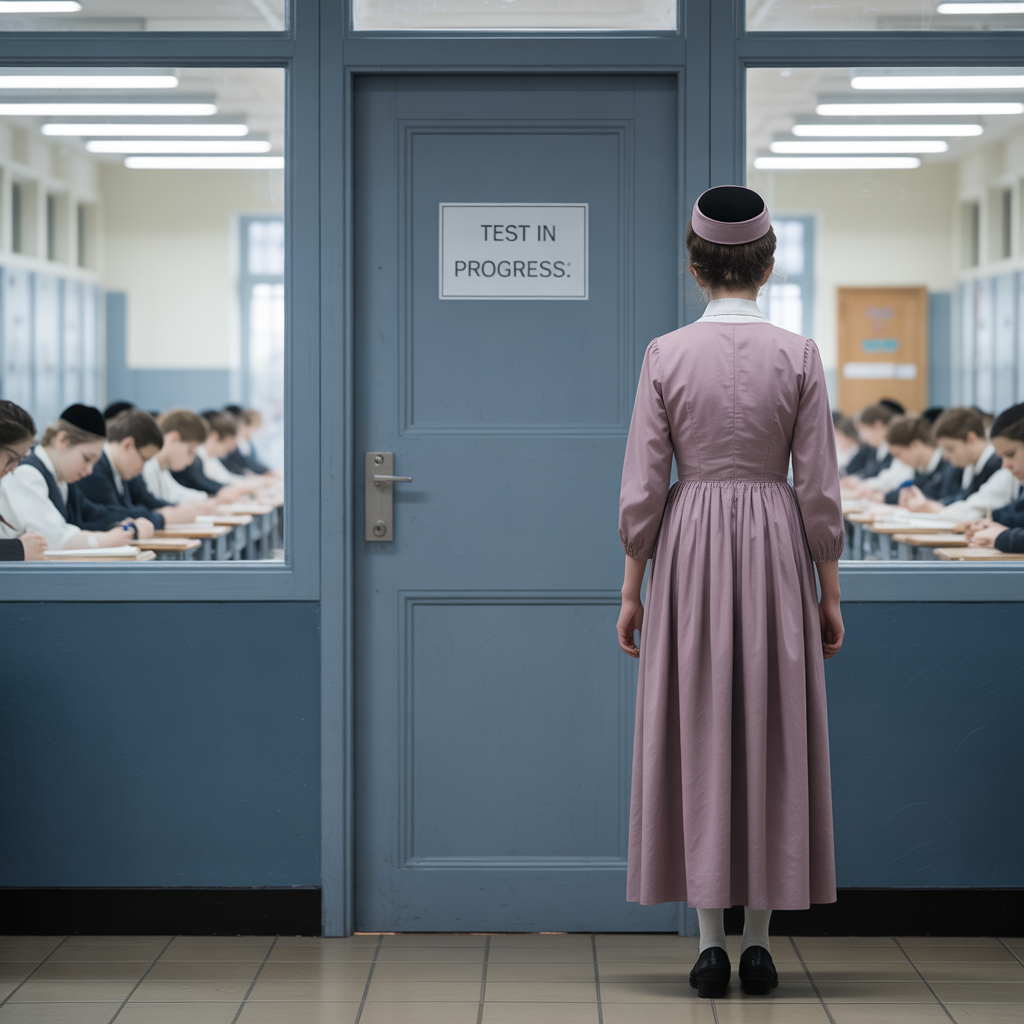
After years of wrangling, the Israeli Supreme Court ordered the Chief Rabbinate to allow women to take its rabbinical exams. When three women recently came to become the first ever to take Israel’s rabbinic tests, they were sent to a separate building and made to wait for hours. Shalzed tries to understand why a test about knowledge isn’t only about knowledge.
Can a State Fund What it Doesn’t Believe?
I was almost done grading my 8th graders’ homework when Shalzed called. “Why aren’t women being allowed to take tests?” he asked. “Doesn’t Israel believe in equal rights?”
“What are you talking about?” I asked.
“Three women are being denied the right to take rabbinical exams administered by the Chief Rabbinate.”
“Well that’s different,” I told him. My kitchen table seemed to wobble. “According to Jewish tradition, only men can be rabbis.”
“But I thought tests are just about knowledge,” Shalzed said. My kitchen seemed slanted, then farther away. There was darkness for a moment, and then I was standing next to Shalzed in a plain room set up with small tables and folding chairs. Three women, dressed in skirts, with their heads covered, were sitting together sharing a bag of chips. They looked anxiously at us.
“So do you have the exams?” one of them asked.
I looked around, feeling uncertain. “Of course not,” I said. “We don’t have anything at all.”
“We’ve been waiting more than four hours,” she said.
“There was already an appeal to the Supreme Court. The Rabbanut either has to give us the exam, or cancel the men’s exam as well,” the woman next to her added.
“I don’t understand. . .” Shalzed began.
This, I could explain. “In Israel, the Rabbanut controls marriage, divorce, kosher certificates, and stuff like that. And since they’re Orthodox, they won’t allow women to be rabbis.”
“But we aren’t asking to be called rabbis,” the three women said together. They were so in unison that I almost laughed.
Shalzed looked perplexed. “Well, if you pass the rabbinic exams, why wouldn’t you be rabbis?”
“For women to become rabbis would be too much of a change,” one of them said.
Shalzed blinked three times. “But if you agree that you’re not allowed to be rabbis, then why do you want to take the rabbinic exams?” he asked.
The woman who hadn’t spoken yet let out a loud sigh. “We want to be able to fill roles that halacha does allow,” she said.
“There are other jobs we can do. Like kosher supervising. And the tests should finally put us on an equal pay scale with rabbis if we teach in religious school,” the first one added. “And the Rabbanut has to let us, since they are funded by the Israeli government.”
Another woman, also modestly dressed, entered the room. “The tests are on their way,” she said. The three women clapped. “We just have to wait for the other proctors to arrive.”
“So you want to pass the rabbinical exam in order to get jobs usually done by rabbis but not be called rabbis yourselves?” Shalzed asked again.
“Just for now,” the proctor said before any of the three could respond.
“Not true,” one of the three said back.
The proctor turned to Shalzed and me. “That’s the problem,” she said. “Today, they say they don’t want to become rabbis. But eventually, they will.”
“And what’s wrong with that?” Shalzed asked. “Aren’t men and women equal?”
“Because the Chief Rabbinate is Orthodox, and it’s up to them,” one of the women said.
“Even though the Chief Rabbinate is funded by the government,” I added.
A man, clearly a rabbi, came into the room. He was wearing a black suit jacket, black hat, had tzitzit hanging out, and was carrying a large briefcase. He was accompanied by another woman proctor. “We’re ready to begin,” he said. The three women quickly sat at separate tables and put away their snacks.
“Who are you?” the rabbi asked, noticing us.
“Can you explain why the government of Israel funds the Chief Rabbinate if the Rabbinate doesn’t believe in equality for men and women?” Shalzed asked.
He gave Shalzed a funny look. “That’s clear- Israel is a Jewish state, so it needs the Rabbinate to maintain the state’s Jewish character.”
“But if the Rabbinate doesn’t treat men and women equally, it’s not compatible with the state,” I added.
The rabbi shrugged. “Even though it’s government funding, the Chief Rabbis are completely independent,” he said.
“So they want the state’s funding, but to still be free to go against its values,” I said.
The three women looked impatiently at the rabbi’s briefcase. “We need to get started,” one of the proctors said.
The rabbi looked at me. “Obviously, the Rabbinate are the only ones who can decide matters of Jewish law. The government has no business in that.”
The room started to feel more distant.
“Good luck on the test,” I said to the women as I felt myself drawn into the familiar blackness, then a moment later I was back in my apartment. I put a hand on the kitchen table to steady myself. I looked around, but Shalzed wasn’t with me.
I took a moment to catch my breath, then noticed the pile of homework still on the table. Shira Tavor’s paper was the only one left. I was happy that my day school taught boys and girls together. But that was our decision, not because of the government. If the government tried to change our religious curriculum, I wondered what we’d do.
Subscribe to Receive Shalzed's adventures in your inbox
One story or question each Friday in your inbox
Glad You're On Board
You'll receive an email each Friday, one week a story, a question the next.
All of Shalzed's emails are sent via Substack.
Sources:
An account of how the women were initially not allowed to take the test, then given the tests four hours later from Times of Israel.
News coverage from the Jerusalem Post.