A No Show in Geneva: Shalzed’s Wake-Up Call About Human Rights
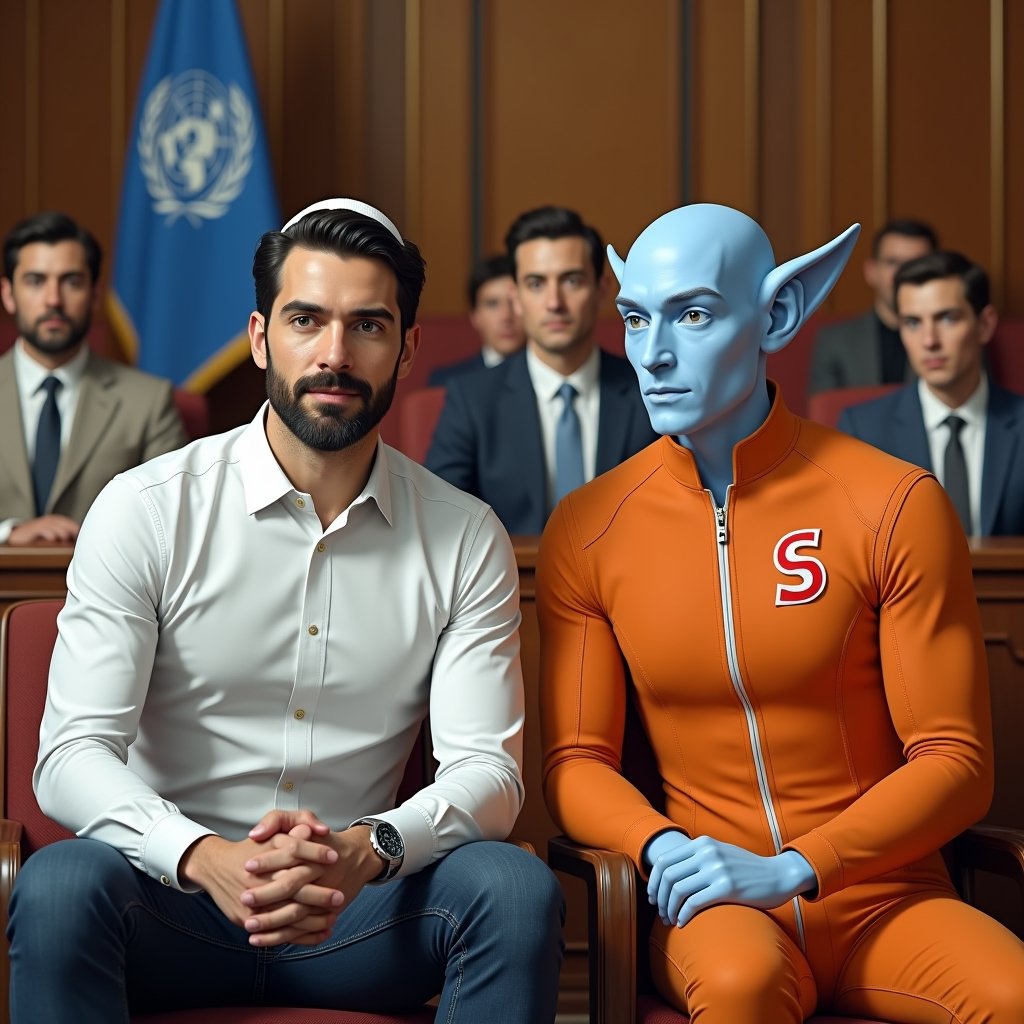
This week Simon and Shalzed go to Geneva to watch the United Nations Human Rights Council critique states’ records on human rights. Shalzed is impressed, until a certain nation fails to show up. . .
Shalzed was particularly excited about the United Nations, and when he heard that it had a special human rights council he wanted to go there right away. “It’s in Geneva,” I told him, afraid he might be disappointed.
“Let’s go now,” he replied, oblivious not only to the distance but also that it was a school day and I had classes to teach.
“Maybe over winter break?” I suggested.
Shalzed put his hands on his hips, and I instinctively stepped backwards. “My mission is urgent, and you said you would help.”
I shrugged. “Okay, but Geneva is in Switzerland, and I teach both 7th and 8th grades today Mishnah and Hebrew. The school. . .”
“You’ll be back in plenty of time,” he said sharply.
What happened next is somewhat a blur. I sensed being inside some sort of enclosed area, maybe a tube, or maybe I was just surrounded by some sort of force field or something like that. Then we were seated together in the gallery of an ornate conference room. It didn’t take me long to figure out from the signs and delegates that we were somehow at the UN Human Rights Council.
“How did you. . .” I began.
Shalzed shook his head. “It’s best we don’t talk too much about technology.”
“But it’s not possible. . .”
He pointed to the head table, where a representative of Honduras was answering a question. “Just tell me what’s going on?” he said.
But I wanted to understand what had happened. “How can we. . .” I began.
He shook his head again. “Someday humans will invent better means of travel. You are already somewhat advanced. After all, you have ice cream.” The first time Shalzed saw soft serve ice cream he had no idea what it was. He couldn’t understand how it could both be formed into swirls and yet still stay upright on the cone. He quizzed me endlessly about it and was disappointed when I couldn’t explain.
I pulled out my phone to check the time. Less than ten minutes ago I had been back home. “How did you. . .”
He smiled and pointed to the dais, where the woman from Honduras was still speaking. “Just tell me what’s going on.”
I resigned myself to waiting for another chance to ask about transport. “This looks like what’s called Universal Periodic Review,” I whispered. “Every four to five years, each country has its human rights record scrutinized by the council.”
“That sounds like an excellent idea, for all the countries to hold one another accountable for upholding human rights.” He watched the proceedings intently.
I still felt shocked from being transported as the woman listed steps her government was taking to protect journalists.
“Why do journalists need protection?” Shalzed asked. “If there is a fire, or a tornado, don’t they stand far away?”
I laughed. “I think what’s dangerous is when they report on crime, drug trafficking, and corruption. People use violence and intimidation to try to keep journalists from exposing what they don’t want others to known.”
Shalzed considered. A few moments later the session finished and the Honduran delegation got up. The ‘Honduras’ placard was replaced by one that read ‘United States.’
“It’s very impressive that a large, powerful country like the United States allows all of the others to critique it,” Shalzed said. “It shows how each and every country on Earth has a deep commitment to fulfilling human rights.”
A woman in the row in front of us turned and gave Shalzed a funny look. “I guess I stand out a little because of my ears,” he whispered to me, oblivious to his naivety. “But with a human rights council like this, I really don’t understand why Earth has any problems.”
A throng of photographers came and started taking pictures of the United States placard and the empty chairs at the table behind it.
The High Commissioner for Human Rights, Volker Turk, spoke from the podium. “I propose the council express its regret at the refusal of the United States to participate in this process,” he began.
Shalzed stiffened. “But you said every country participates,” he said.
I shrugged. “All the countries are supposed to, but no one can force them. The UN Human Rights Council doesn’t have the power to make anyone to do anything.”
“Why not?” Shalzed asked, his voice suddenly louder. I worried for a moment that he might have attracted security’s attention.
The woman in front of us turned again. “And what planet did you come from?” she asked.
Shalzed was about to answer, but I stopped him. “That’s an expression,” I said. Then I turned to woman. “We came because we’re interested in finding out more about how human rights work in practice,” I told her.
“Well, it looks like you’ve got a lot to learn,” she said as she shook her head and turned back around.
“The United States believes the Human Rights Council is biased,” I whispered quietly to Shalzed. “It has passed more resolutions condemning Israel than all other countries in the world combined. It has a special agenda item against only Israel at every session. And many of the countries elected to serve on the council are the ones with the worst records on human rights.”
Shalzed’s mouth dropped open. “But you said every country has its record critiqued by all the others, so countries can help one another improve?”
“That’s what’s supposed to happen. But in practice, countries use the human rights council to launch political attacks on each other, and join the council just in order to shield themselves from scrutiny.”
“But isn’t there someone in charge who can prevent that from happening?”
I smiled. “Like who?” I asked.
“Like him.” Shalzed gesturing towards Volker Turk.
Turk continued his address from the podium. “I propose we postpone the review of the United States, and call upon it to resume its participation,” he said.
“That’s all he’s going to do?” Shalzed asked. “Why doesn’t he send police to force the United States to come?” I couldn’t help but chuckle as Shalzed continued. “And why doesn’t he stop the council from passing resolutions that are biased, or from ignoring human rights violations committed by powerful countries, or from letting politics drive its focus?”
The woman in the row in front of us turned again. “Volker Turk is only human, you know.” She said.
“The high commissioner is selected by the countries. He works for them. He can’t tell them what to do,” I added.
Shalzed looked down. “So maybe it makes sense for the United States not to participate,” he said. “Maybe it will make them become more impartial.”
The woman shook her head. “This is pretty much the first time ever that a country has refused to attend its review,” she said. “I’m afraid that now others will start refusing too. The whole system for holding countries accountable for their human rights records could easily fall apart.”
The council took a formal vote to express its regret, postpone the U.S. review, and call on the United States to resume its cooperation. Then everyone began to file out. I checked my phone, wondering what time it was back home.
“When is your first class?” Shalzed asked me.
I couldn’t remember whether the anti-bullying assembly was today or next week. “8:51,” I told him, in case we were on regular schedule.
“Fine,” he said. “Come with me.” Shalzed led me out of the building, then when we were on the steps I suddenly had that same sensation of being in a tube with lights or some kind of energy all around. A moment later I was standing in front of the Reuben Goldman Jewish Day School, right where kids get dropped off from carpool.
“How. . .” I began to ask.
Shalzed put his finger over his lips. “So are you on time?”
A bell rang inside the school. I checked the clock on my phone. I had missed davening, although that wasn’t a big deal. All Jewish studies faculty were encouraged to come and usually I did, but it wasn’t required. If we were on regular schedule, first period would be starting in 3 minutes.
“I have to run,” I told Shalzed.
“You said that Israel has been condemned more than all the other countries combined,” Shalzed said.
“Right,” I answered.
“Why is Israel so much worse than all the other countries?”
“It’s not,” I told him.
“So why would. . .” he began.
“I have to go to class,” I said, starting towards the school building. “We’ll talk about it later.”
As I went inside, I realized that the tests I graded last night were still back in my apartment. The kids would be disappointed. I couldn’t very well tell them that I had just been transported to view the human rights council in Geneva, so I only had about two minutes and thirty seconds to think up an excuse.
Sources:
AP News coverage of the U.S. skipping its review
Human Rights Watch comment on the U.S. skipping universal periodic review
The European Journal of International Law for a more thorough and scholarly overview of the background and implications of the U.S. refusing to take part in universal periodic review.
Questions for discussion:
- The UN Human Rights Council is made up of countries. Can countries really be expected to police each other regarding human rights without it becoming politicized? Is there any better way?
- By refusing to participate in its universal periodic review, did the United States make a valid protest that the human rights council is biased and therefore ineffective? Or by not participating is the U.S. undermining whatever good the human rights council does do, without proposing any better alternative?
One story or question each Friday in your inbox
Glad You're On Board
You'll receive an email each Friday, one week a story, a question the next.
All of Shalzed's emails are sent via Substack.