COP30 Leaves Shalzed Wondering Why He Chose Earth
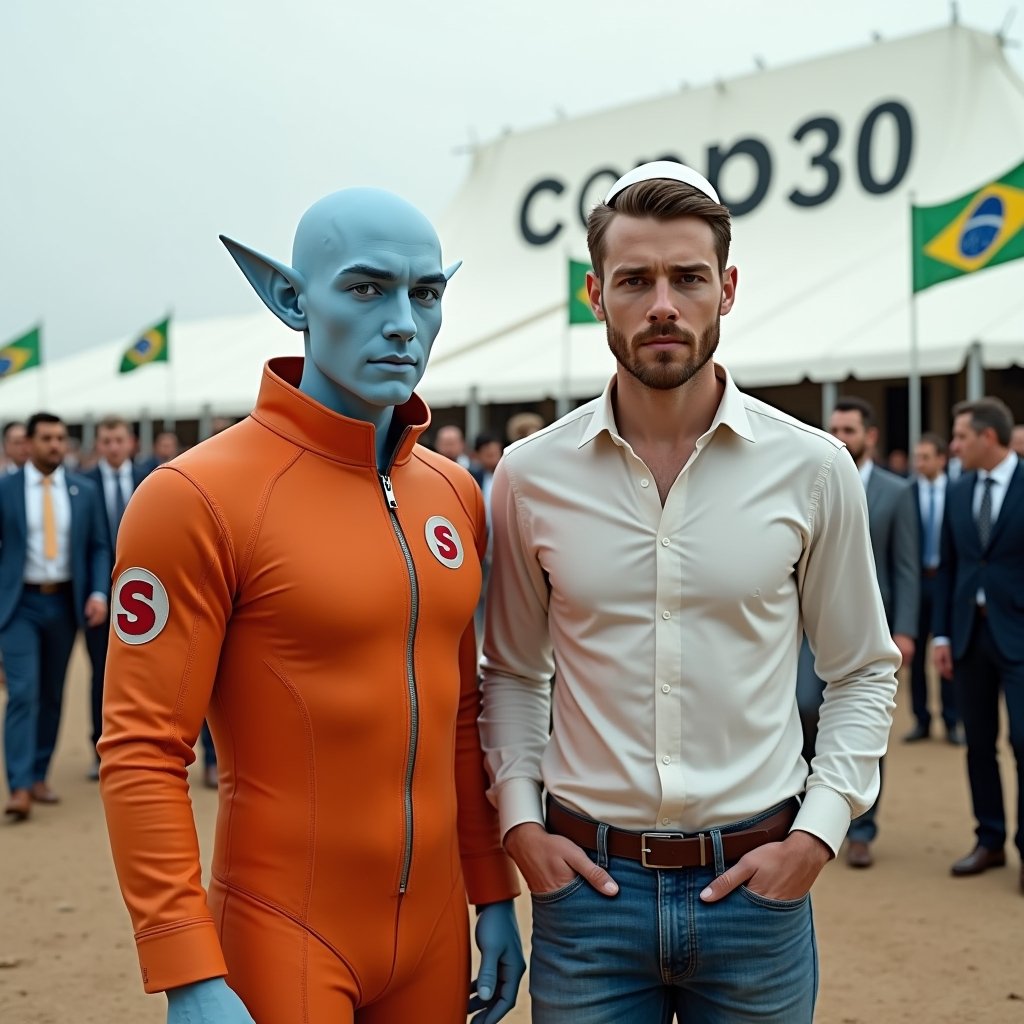
Shalzed came to Earth hoping to learn about human rights and take that knowledge back to his planet. However, a visit to the last day of the United Nations COP30 climate conference leaves him unimpressed.
COP30 Leaves Shalzed Wondering Why He Chose Earth
Shalzed told me that pollution had a devastating effect on his planet. “Everyone produced toxic waste and released it into the air, the water, wherever they wanted,” he said. “Eventually, we had to live in sealed domes.”
So he was excited to hear about the COP30 event in Belen, Brazil, where nearly 60,000 representatives of governments and organizations from all around the world were gathering to discuss climate change. He absolutely wanted to go, so he did his thing where for a short moment I felt like I was floating in nearly complete darkness, with only little pins of light like stars visible, and then all of a sudden we were standing together outside an enormous, air conditioned tent at the edge of the conference Blue Zone. That was the area with strictest security, where only government representatives had access, and the official negotiations were held.
Delegates were streaming out, looking frustrated and tired. I noticed some of the exhibits on new clean energy technology in the area open to the public being torn down.
“What’s going on?” Shalzed asked.
“I think the conference is ending,” I said.
“Wow!” he exclaimed. “That’s incredible. Humans have managed to solve Earth’s climate crisis so quickly!”
I chuckled, but he didn’t notice because he was already trying to get the attention of delegates. “Sir,” Shalzed said to a man hurrying out. “Please tell me what the conference decided.”
The man barely glanced in Shalzed’s direction. “Here,” he said, handing Shalzed some papers. “This is the final declaration. . . You can have it, I was going to throw my copy in the trash.”
Shalzed gave the man a puzzled look. I watched him hurry away, taking off his tie and stuffing it into a pocket, as Shalzed read the document intently.
“It doesn’t even mention fossil fuels, and burning fossil fuels is the main cause of the changing climate,” he said when he finished reading. I shrugged. “And this declaration only says that something should be done. It doesn’t say what, or specify who is going to do it.”
“Well, that’s what happens,” I mumbled.
Shalzed looked incensed. “Excuse me,” he said to another delegate passing by, almost grabbing the man’s arm. The man’s badge identified him as Gustavo Petro, President of Columbia. “I don’t understand. The purpose of this conference was to find a way to stop climate change, so why did you pass a final declaration that doesn’t even mention fossil fuels?”
Petro gave Shalzed a weary look. “Are you with the press or something?” he asked.
“No. . .” Shalzed began.
“He’s just concerned,” I interjected.
“It doesn’t matter,” Petro said. “I’ll say the same thing I’m about to tell the media. This conference was an absolute embarrassment. We need a strong commitment to transition to alternative energy and move away from fossil fuel, and I’m outraged that didn’t happen. The minor agreements we reached about deforestation and adaptation aren’t nearly enough. The countries standing in the way should be ashamed.”
Shalzed wrinkled his forehead. “Countries standing in the way?” he asked. “But why would any country do that?”
A security guard moved between Petro and Shalzed. “If you’ll excuse the President,” he said very firmly, but at least somewhat polite. “Press conference,” he said to Petro, guiding him away.
Shalzed turned to me. “Some countries are afraid transitioning away from fossil fuels will harm their economies,” I told him.
“Do they think their economies are more important than the health of the planet?” he asked.
Once more I shrugged. Shalzed turned back to the parade of delegates walking by. Most ignored him. Then a man with his suit and tie still in place turned when Shalzed tapped him on the shoulder. His badge identified him as Vladimir Uskov, chief negotiator from Russia.
“Can you tell me why any country would want to prevent transitioning away from fossil fuels?” Shalzed asked.
“Were you playing games over at the windfarm exhibits during my speech?” Uskov asked.
“We just got here,” I told him, before Shalzed could reply.
“It’s very simple,” Uskov snapped. “Russia is a sovereign country, just like everyone else. We want to set our own policy on energy without having it dictated by international organisations or the UN. Fossil fuels are the backbone of our economy, and if we abandon them abruptly millions of our people will suffer. That’s not a just transition. We need to use all pathways going forward, and fossil fuels must remain a part of the mix.”
“But if all countries don’t cooperate in reducing emissions, climate change can reach a tipping point where the effects will be impossible to reverse,” Shalzed said.
“Alarmist nonsense,” the Russian replied, waving his hand. “Climate projections are extremely uncertain, and it’s very likely technology will be invented in the future to manage the threat.” A woman on her way out called to him in Russian, and he hurried to join her.
Shalzed crossed his arms against his chest. “I don’t get it. I assume most countries understand the urgency of the climate crisis, even if Russia doesn’t. Why didn’t they just hold a vote on whether or not to take strong action, and Russia would lose?”
I smiled. “That’s not how these conferences work,” I told him. “Everything has to be agreed to by consensus.”
“Consensus? You mean you only take action when all of the nearly 200 countries agree? Any one of them can stand in the way?”
“Pretty much,” I said. “Russia has a few allies, countries whose economies are based on coal or oil. Together they are able to block almost anything.”
“But why?” Shalzed asked.
“That’s just the way it works. Like the Russian delegate said, each country is sovereign. There is no mechanism to force any country to do anything it doesn’t want to.”
Shalzed considered. “What about your country?” he asked. “The United States is one of the largest economies. Let me find one of their delegates. If the United States takes action, even on its own, that would make a big difference.”
Shalzed began scanning the ID badges the exiting delegates were wearing around their necks.
“I don’t think you’ll find anyone representing the U.S.,” I told him.
“Why not?”
“The United States refused to come.”
Shalzed turned in surprise. “The U.S. didn’t come? But why not? Climate change affects the entire planet. And you said this conference is. . .”
“The President of the United States believes climate change is a hoax,” I interrupted. “He is actually trying to increase production of fossil fuels. He says all the science indicating that emissions from burning fossil fuels are changing the climate is wrong, and this is all just a big scam that will hurt the economy.”
Shalzed looked around, looking a bit flustered and bewildered. Then I saw back in the darkness, floating with lights around me, and a moment later we were standing outside my apartment.
“But what about human rights?” he asked while I was still trying to get my bearings. “Climate change can cause people to lose their housing and their access to food. It will affect health and destroy livelihoods.”
“Yes,” I told him. “But that doesn’t mean any particular country is obligated to act.”
“I’m starting to wonder whether Earth was even worth coming to,” he said, his voice gloomy.
“At least you found out about soft serve ice cream,” I told him. He had been utterly amazed at how it was able to be swirled and maintain that shape in the cone.
“I have to think,” he said to me.
“And I have homework from my 7th and 8th grade mishnah classes that I have to grade.” Shalzed started walking away with his head down. He kicked a small rock from the sidewalk out into the street. “There are good things on Earth too,” I called after him.
He turned around to look at me. “I hope so,” he said. “I really hope I didn’t come all this way for nothing.”
Subscribe to Receive Shalzed's adventures in your inbox
One story or question each Friday in your inbox
Glad You're On Board
You'll receive an email each Friday, one week a story, a question the next.
All of Shalzed's emails are sent via Substack.
Sources:
News coverage of Cop30 from Reuters
From the BBC
From Climate Change News
Question: International law respects the sovereignty of all states, so there is limited ability to force countries to take action and also limited ability to hold states accountable for fulfilling whatever climate commitments they may make. Is international law up to the challenge of addressing climate change, which requires all countries to take strong action and work together? Is there any alternative?