A statue gets 75,000 reactions. The war gets less.
A single photo goes viral. Shalzed wants to know why this one—and not the others.
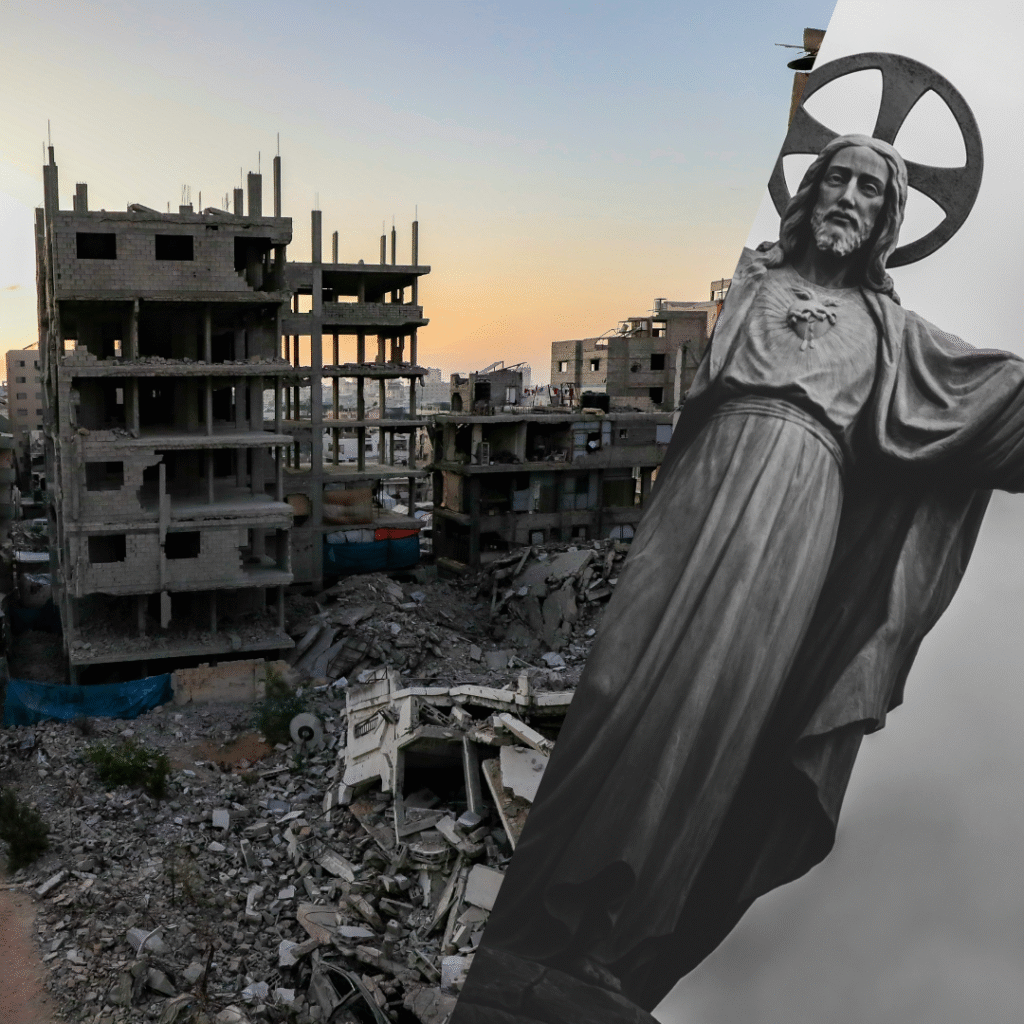
A photo of a statue of Jesus being smashed gets hundreds of thousands of reactions.
Photos of actual people suffering don’t get anywhere near the attention.
This week, Shalzed asks why.
A statue gets 75,000 reactions. The war gets less. Shalzed Wants to Know Why.
After school, I met Shalzed at Stop’n Shop. He was fascinated by what we ate, and wanted me to explain what some of our processed food products were.
“But why do you put acids that decay teeth inside your water?” he asked when he saw a display of coca-cola at the entrance.
“Some people like it,” I told him. “And if so many people drink it, it can’t be that bad.” I was trying to decide whether I should mention that in the summer I sometimes got coke slurpees at 7-eleven when my phone buzzed. I swiped and it was a notice asking me to check out a viral post on Facebook.
“Can I see it?” Shalzed asked, looking over my shoulder.
I held up my phone. It was a picture of an Israeli soldier destroying a statue of Jesus somewhere in Southern Lebanon, under the headline, ‘This is what impunity looks like.’ It already had 75k reactions and thousands of comments.
“I don’t understand- it’s a statue,” Shalzed said.
At school, people had already been talking about this in the teachers’ lounge. “Yeah, but it’s a statue of Jesus. Christians are offended.”
“Has any photo showing people killed in the war gotten anywhere close to that many likes?” he asked.
“Excuse me, you’re blocking the aisle,” a familiar voice said from behind me. I turned to see Rabbi Meyer pretending to reach for a the two liter bottle.
“Have you met Shalzed?” I asked. “He’s from. . . far away.”
“Yes, we met once outside the library,” the rabbi said. That’s right- Rabbi Meyer had passed by when we were discussing the story of Purim.
“We were just talking about why the photo of the IDF soldier destroying the Jesus sculpture is so viral on Facebook,” I said, hoping to change the topic. I didn’t want the rabbi to ask any more questions about how I knew Shalzed.
“So horrific,” Rabbi Meyer replied. “It’s a desecration of God’s name. I already signed a statement of Jewish leaders offering an apology.”
“You must issue statements every day, then,” Shalzed said.
Rabbi Meyer frowned. “What do you mean?”
“Countless people have been killed over the last three years. Tens of thousands are homeless. . .”
Rabbi Meyer interrupted. “The photo of the soldier destroying the statue is uniquely harmful to Israel’s image. It could ruin relations with the Christian community, just when we need allies the most.”
“So the main problem is image?” Shalzed asked.
“I think he means that this photo is being exploited by people who want to stir up hatred of Israel,” I interjected.
“That’s right,” Rabbi Meyer said. He stepped past Shalzed to grab a bottle of cherry coke and put it in his cart. “Antisemitism is at an all time high. Just last week, synagogues were attacked in London. The last thing we need right now is a picture like that.” He began pushing his cart towards the produce.
“See you in shul,” I said as he went over to the grapes. I turned to Shalzed. “It gets so much attention because Jesus is a religious symbol,” I said.
“And symbols are what matter most?” he asked.
“No,” I said quickly, but I couldn’t think of a good explanation. Do you want me to show you the cereal aisle? There are probably more than a hundred different kinds.”
Shalzed ignored me. “Has any other picture of the war gotten as much attention?”
I told him I didn’t know, then paused to consider. “It’s just that in this picture it’s obvious that the soldier is doing something wrong,”
Shalzed shook his head. “Humans only know what’s wrong when the victim is a statue?”
I clicked my tongue. “It’s not that,” I told him. “It’s just that most of the time the facts are complicated. Here, it’s simple- why destroy a religious object?”
A mom came into the store, pushing a young child in a dinosaur shaped shopping cart. The kid pointed eagerly at the coca cola, and the mom sighed. She reached around Shalzed, hardly noticing he was there, and picked up a two liter bottle. “I’m putting this in the cart now, but I’ll only buy it if you behave nice the whole time we’re in the store,” she said. The child clapped, then they also headed towards produce.
“Children drink this too?” Shalzed asked. He wrinkled his nose and began blinking.
“Sometimes,” I told him. “Let me show you the cereal.”
Shalzed blinked again, and I could tell his mind was still on the photo. “Is the soldier going to be punished?” he asked.
I checked my phone. “Not only was the soldier who smashed the statue already put in prison, but Israel replaced the statue with another one as well,” I told him.
“It’s been less than two days,” he exclaimed.
I smiled. “That’s right,” I said. “Every army has soldiers who break the rules, but Israel at least tries to do what’s right.”
“What about other accusations against Israeli soldiers? Why don’t those investigations move as quickly?”
“I don’t know. Why don’t we go to the cereal aisle so we’ll be out of the entrance.”
An obese man in a mobility scooter stopped right next to me and said excuse me in an annoyed tone. I stepped aside and he reached over to grab a bottle of diet coke. “Lots of people coming through here,” he mumbled at us as he continued into the store. “Maybe run for Congress if you just want to stand around.”
Shalzed turned away from me, and fixed his gaze on the coke display. “So only when there’s a photo that makes things clear, you act immediately. Otherwise, you just argue,” he said.
“Not exactly,” I told him.
Shalzed pointed to a big picture of smiling people holding cans of coca-cola on the wall above the bottles. “Maybe simple images like that are why humans drink acid water without asking questions,” he said.
He paused. “And don’t act unless the situation is obvious.”
Subscribe to Receive Shalzed's adventures in your inbox
One story or question each Friday in your inbox
Glad You're On Board
You'll receive an email each Friday, one week a story, a question the next.
All of Shalzed's emails are sent via Substack.
Sources:
For more information on this incident from Times of Israel, click here.
For details on the international statement of apology from the Jerusalem Post, click here.
For information on the soldiers’ punishment from Reuters, click here.