Low Standards on the High Seas
Was blowing up a boat of drug smugglers alright?

Wednesday, Sept. 2nd, the U.S. military attacked a boat in international waters in the Caribbean. The U.S. claims the boat was smuggling drugs into the country, and as a result of the attack all eleven people on board were killed.
How does this U.S. attack fits into human rights and humanitarian law. Was this legal on the part of the U.S.? Was it wrong for the U.S. to do? Or does it show flaws in the international legal system? Explore below.
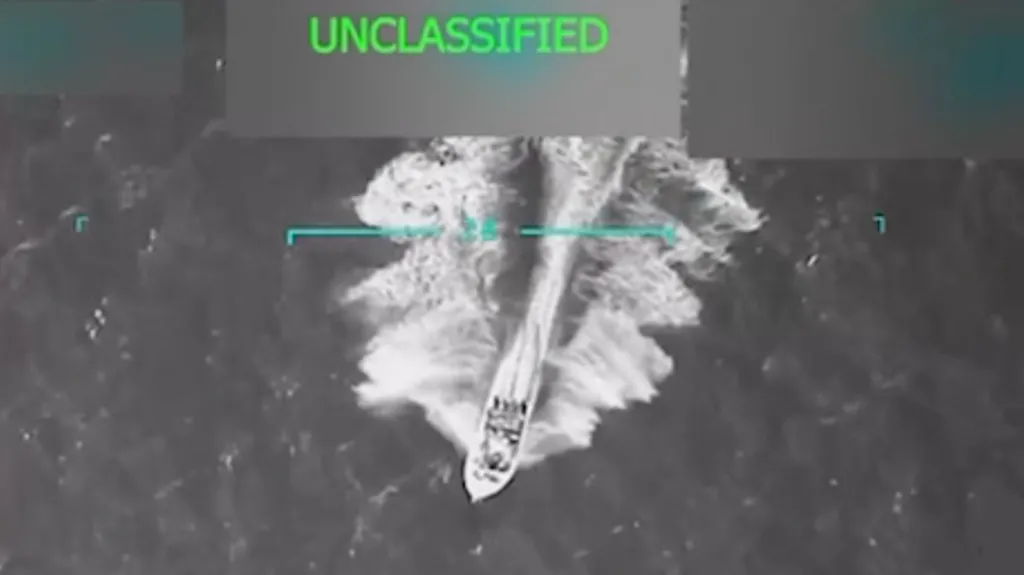
Image of the boat moments before the attack released by Donald Trump on Truth Social. Trump claims ‘bags of drugs were all over the boat’ but that does not seem to be clear from any of the photos.
Criminal Law
The U.S. government certainly can make it a crime to import drugs and to punish anyone who tries to do so. However, Article 11 of the Universal Declaration of Human Rights begins:
Everyone charged with a penal offence has the right to be presumed innocent until proved guilty according to law in a public trial at which he has had all the guarantees necessary for his defence.
In other words, if this was a boatload of criminals they would have to be arrested and put on trial. A trial is particularly important because the government has not offered any evidence that these were drug smugglers, and the fact that 11 people were on a boat that could easily be crewed by just 2 or 3 points to this being some sort of human trafficking ring and not drug smugglers at all. So before punishing the people on the boat, a judge or jury would have to be convinced that they really were smuggling drugs.
If U.S. authorities had attempted to stop the boat and it had responded by trying to flee, or by firing on the U.S. ships, that would have been a legal rationale for use of force. But in this case it does not seem the U.S. even made an attempt to apprehend the boat. Instead, U.S. forces just destroyed it with no warning.
Any scenario in which a U.S. President unilaterally declares a group of people to be drug smugglers and orders them killed with no judicial oversight is a violation of human rights. The good news is that at least as of now I don’t believe that even the Trump administration is claiming the right to do this.
Self-Defense
The U.S. claims the boat did not contain just random individuals smuggling drugs for their own personal financial gain, who would have to be treated as criminals, but rather it was operated by the Tren de Agua gang. The administration has labelled Tren de Agua ‘narcoterrorists’ and claim the gang is a threat to the United States.
This leads a claim of self-defense. For example, U.S. Secretary of State Marco Rubio was quoted as saying, “These are organized, corporate, structured organizations who specialize in the trafficking of deadly drugs into the United States of America. They pose an immediate threat to the United States. Period.”
However, this assertion may not survive legal scrutiny. The internationally recognized right to self defense is codified in Article 51 of the UN Charter, which reads:
Nothing in the present Charter shall impair the inherent right of individual or collective self-defence if an armed attack occurs against a Member of the United Nations. . .
Is drug smuggling an armed attack? It’s hard to see how. In fact, it would seem like the phrase ‘armed attack’ was carefully selected to exclude criminal activity and make clear that states can invoke a right of self-defense only against military attacks, not criminals.
Of course illegal drug use causes tremendous suffering, economic loss, and deaths. But so do many other societal ills. The fact that something is harmful (or even criminal) doesn’t mean the government has a right to resort to extrajudicial killing to defend us from it.
Armed Conflict
The U.S. government, with its rhetoric about the ‘war on drugs’ and labelling Tren de Agua as terrorists, makes it seem as though it is engaged in what would be called a ‘non-international armed conflict’ with the gang. In armed conflict it is permitted to attack enemy combatants without warning and without judicial process, as happened here.
However, there are some major issues. First, it’s not clear that Tren de Agua is really a ‘non-state armed group’, or even if it is that the U.S. is currently at war with it. That would hinge on a lot of factual questions about Tren de Agua’s size, level of organization, armaments, and activities which are hard to answer.
But even so, it’s not clear that even in the context of an armed conflict it would be legal to blow up the boat. In armed conflict it is only permitted to target enemy combatants. Even if the boat was smuggling drugs, and the drug money was used to fund the war, drug smugglers would likely still be viewed as civilians. They would seem to be just like enemy citizens who even though they may play a role in enabling the military effort are still not part of the military themselves. The U.S. might allege that in this war, drugs are a weapon, but that’s very hard to justify. By similar logic countries could say that information is a weapon so journalists or bloggers are targets, or the like.
Questions
So I end with two questions. First, was the sinking of this ship somehow justified under international law, or was it an illegal act of violence?
Second, how important is it that military actions such as this comply with international law? Even if this sinking was illegal, there wouldn’t seem to be any consequences, and for many years the U.S. has struggled mightily to stop the flow of drugs. If sinking a few boats will help keep large quantities of deadly drugs off U.S. streets, is it worth it? If international law doesn’t provide an affective path to stop drug smugglers is the U.S. entitled to just do what it seems necessary? While perhaps in we all benefit from living in a world based on law and rules, since these international laws are seldom followed, never enforced, and exploited by criminals is it okay for countries to sometimes just not follow them?
Notes
- For more discussion of these issues in the media, see this analysis on ABC News and this article on the BBC. For a more scholarly treatment, see this piece on Just Security.
- A separate legal question was whether Trump was within his authority to carry out this attack without authorization from Congress. Since that is solely a U.S. domestic matter it is not addressed here.
One story or question each Friday in your inbox
Glad You're On Board
You'll receive an email each Friday, one week a story, a question the next.
All of Shalzed's emails are sent via Substack.