Punished for Prayer?
Shalzed speaks with Quebec minister Jean-Francois Roberge about new law to forbid praying in public
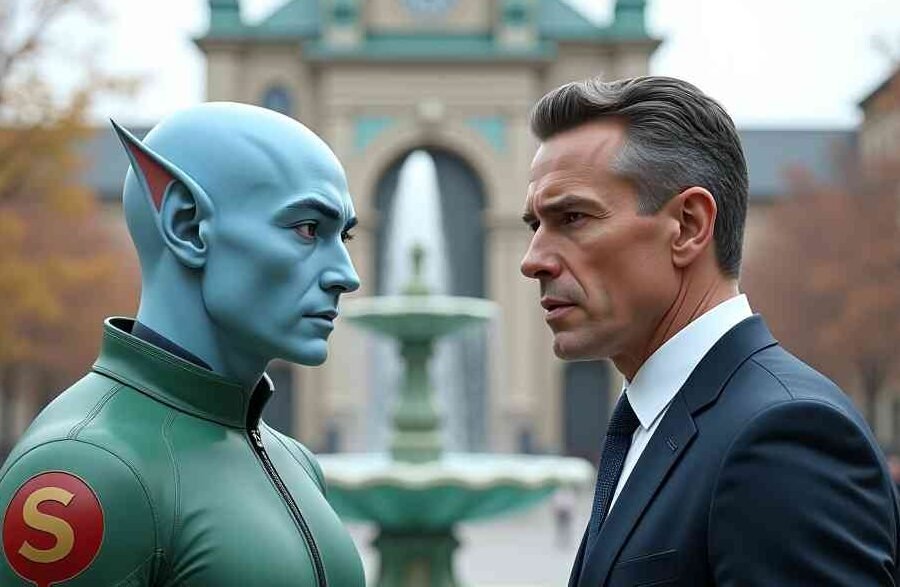
Quebec recently proposed a law forbidding prayer in public places. Shalzed catches up with that province’s Minister of Secularism Jean-François Roberge to find out how he doesn’t see this as a violation of religious rights.
I waited outside the Hôtel du Parlement du Québec, watching water flow through the Tourny Fountain. I have no idea why the fountain has so many elaborate carvings of fish. On my planet there are very small oceans, so everything to do with marine life is foreign to me.
An English speaking family rode by on the kind of bicycles you rent from automatic docks by the minute. I assumed they were from South of the border. In Montreal it’s common to hear English, but not all the way up here in Quebec.
“Bonjour,” I called as Jean-Francois Roberge approached, striding quickly on his way towards parliament.
He nodded and waved at me without slowing down. Roberge has only been in politics for about ten years, when he gave up life as a teacher to serve the proud people of Chambly in Parliament. But evidently that’s been plenty of time for him to get good at brushing people off and to learn to make himself look busy. “Oh father in heaven, may you appear before us and spread your blessings far and wide like insecticide from a crop duster,” I began.
Now he slowed down. “Shalzed?” he exclaimed.
“Sorry, I’m in the middle of a prayer,” I said. A young Muslim couple, just finished taking a selfie in front of the fountain, gave me a funny look.
Roberge rolled his eyes. “I’m sure you’re not praying. There must be no religion where you come from.”
That was true. On my planet we have nothing comparable to what humans call religion, and we have long since disproved the existence of any sort of supernatural power. “Okay, you’re right. But I was exercising my right to pray. Before you pass a law telling all citizens of Quebec what they must and must not believe in.”
Roberge gave me what I’d best describe as a snort, probably how he used to react when a middle school student got sassy. “No one is going to tell Québécois what to believe. And people can still pray, just not in public. I think that’s very fair.”
The Muslim couple took a few steps, but lingered by the fountain. I had the feeling they were listening. Fine with me. “And here I thought freedom of religion was a fundamental right,” I said to Roberge. “Isn’t it even in the Universal Declaration of Human Rights, or am I mistaken?”
“Absolutely,” Roberge agreed.
Smart, because I knew I was not mistaken. “So I’d say prayer is pretty fundamental to freedom of religion. And your new law tramples that right.”
“Not in the slightest,” Roberge said. “Here’s an example. People have the right to have children. But you don’t do it in a public park, you do it in your bedroom.”
The Muslim woman who was listening smiled, while the man she was with started laughing. “That’s ridiculous,” I said.
“The point is that people praying is not the sort of thing we want to see in Quebec,” Roberge said. “Whoever wants to pray is welcome, but do it in your church.” He noticed the Muslim couple and added, “Or mosque, synagogue, or whatever you call it. But prayer is not what public places should be used for.”
“And what’s so bad about prayer? Does it hurt someone?” I asked, genuinely clueless as to why he was so adamantly opposed to displays of religion in public.
A man wearing a dirty T-shirt advertising the dates and cities of some long ago concert tour and sneakers held together with masking tape walked straight up to Roberge with his palm extended. Roberge glanced at me and also the Muslim couple, then took out his wallet and handed the man a loonie. I thought the man would come to me next, but instead he walked right past me and went to the Muslim couple.
“Are you going to make a law against asking for money? I assume the site of needy people begging is not something you want in Quebec either,” I asked Roberge.
“Those are completely different things,” Roberge said as he put away his wallet.
“Really?” I asked.
“Absolutely,” Roberge said as he folded his arms across his chest. “There are facilities specially designed for prayer. Churches and the like. So there is absolutely no reason why people should be allowed to take over public places being used by others in order to do it. For beggars, there is nowhere else they can go.”
The Muslim woman gave the man a coin from her purse. Then he headed away, in the opposite direction of Parliament, towards the Plains of Abraham park.
“I’m curious,” I asked Roberge. “Let’s say there is yoga in the park, and it begins with meditation. Will that be forbidden as public prayer? What if there’s a picnic, and someone says grace or a blessing over the food?”
Roberge swallowed. “The law will be enforced sensibly,” he said. “The police will only issue tickets where the prayer is a major or prominent part of a gathering’s purpose.”
“Sounds pretty subjective to me,” I said.
The Muslim woman walked closer, pulling her partner along. Roberge seemed to resign himself to the fact that there was no tactful way he could avoid her. “How do we know you won’t enforce the prayer law only against Muslims?” she asked.
Roberge waved his hand. “The government of Quebec would never do such a thing,” he said. “This law will apply equally to everyone.”
The woman laughed. “That’s very hard to believe, since the fact that you don’t like the prayers at the rallies for Palestine is what got this all started,” she said.
Roberge cleared his throat. “I need to be going,” he said. He pulled out his phone like he was checking a message.
“So you think it’s alright to take away people’s freedoms in public, as long as they can still exercise those same rights at home?” I asked him.
Roberge shook his head. “People absolutely have the right to pray, but only in their home or in their house of worship. Anything beyond that is an attempt to impose religion on others,” he said. “Now I have to head straight to the Salon Rouge.” He put his phone back in his pocket and started to walk away.
“À la prochaine,” I said, feeling certain that with Roberge’s aggressive secularism I’d be back to see him soon.
He waved a hand at me. “Good luck finding a way back home,” he said. “So then you’ll leave us alone.”
I caught the eye of the Muslim woman and we exchanged a smile as Roberge walked away. “Why is your skin blue?” the man she was with asked me.
I shrugged. “I’m just a little different. You see, we’re both minorities.” I don’t like giving humans too many details about my planet so I started towards the park. The couple did not follow.
I wanted to tour Quebec’s old city, so I decided to rent one of those pay per minute bikes to get around and I spotted a kiosk nearby. As I approached, two women wearing long dresses and carrying signs saying that two questions could determine if I was going to heaven or hell asked me whether I owned a copy of the Bible. I told them no, and so they shook their heads and offered me a pamphlet summarizing the teachings of Jesus. I decided to walk to another kiosk rather than be stuck with them watching me while I tried to figure out how to rent a bike.
I wondered if Roberge’s next law would forbid people like this from passing out religious literature in public. That might remove a minor inconvenience, but I hope he doesn’t do it. There’s an awful lot it’s worth putting up with in order to preserve freedom and rights.
Subscribe to Receive Shalzed's adventures in your inbox
One story or question each Friday in your inbox
Glad You're On Board
You'll receive an email each Friday, one week a story, a question the next.
All of Shalzed's emails are sent via Substack.
Discussion Questions:
- Is a prohibition on public prayer a violation of citizens’ religious rights, even if prayer is still allowed at home and in houses of worship?
- If public prayer is forbidden, what stops a government from defining prayer or enforcing the law selectively in a way that discriminates against disfavored religious groups?