
Do Courts Make Wars Last Longer?
Shalzed attends a conference on ‘The End of War’

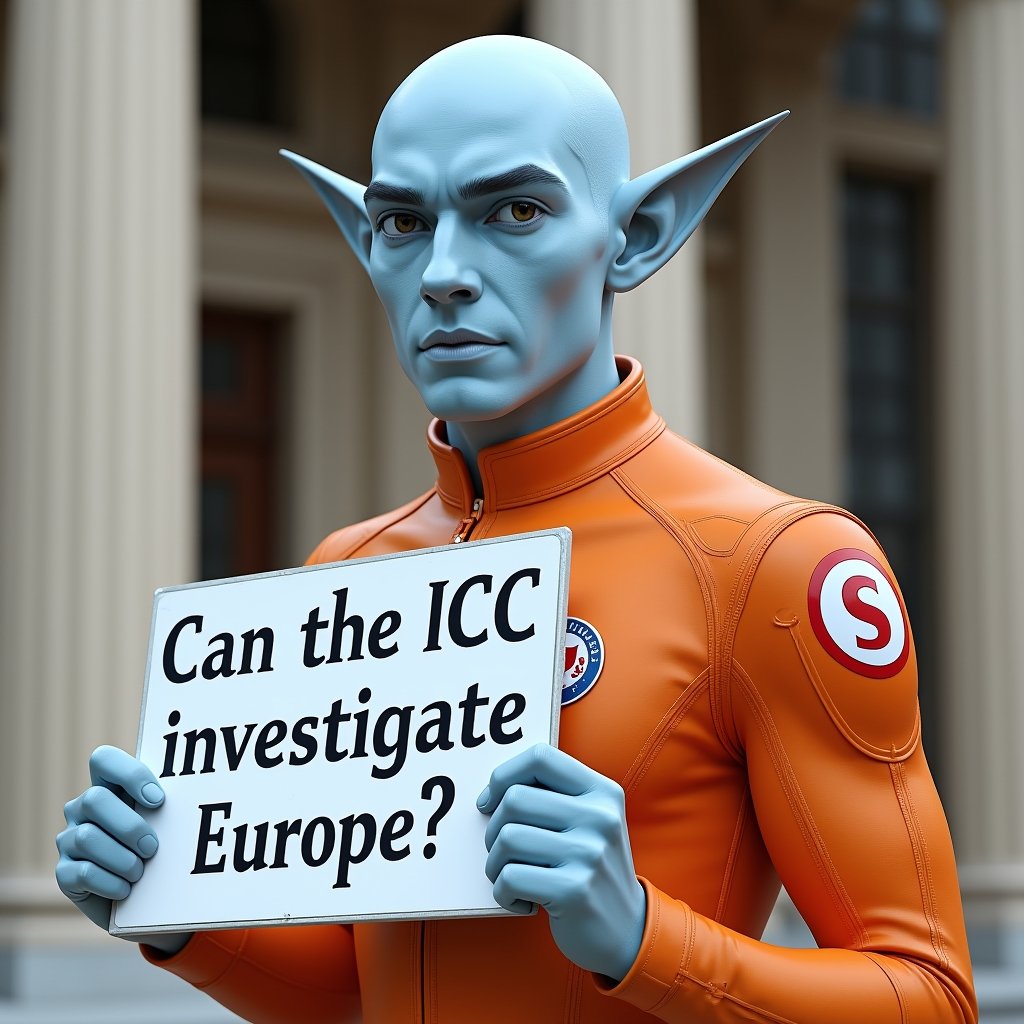
Can international courts help end wars — or do they unintentionally prolong them? Shalzed goes looking for answers. . . and also tries some new cookies at a conference.
Do Courts Make Wars Last Longer?
Shalzed heard about an academic conference titled “The End of War.” Personally, I doubted whether a bunch of college professors really had secrets that could help save the galaxy, but Shalzed was adamant about going. Since it was over President’s day weekend when I had off of school, I agreed.
When we arrived Shalzed was immediately drawn to a platter of round, green cookies next to the coffee. “Are these regenerative nutrient capsules to heal all who have been wounded?” he asked.
I laughed. “No,” I told him. I pointed to a small sign that said, ‘White chocolate matcha energy bites.’ He ate five, and then I steered him towards the hall where the sessions were because people around the coffee table were starting to give him dirty looks.
There were some introductory speeches, and then a session titled ‘Climate Change as a Conflict Multiplier’ in which panelists took turns explaining how much worse today’s problems were going to become.
“They aren’t giving ways to make peace at all,” Shalzed whispered. I shrugged.
The next session was two women from different universities speaking about the role of international courts in ending wars. One was named Laurie Blank, and the other Daphné Richemond-Barak. Shalzed seemed upset as they explained why courts were of limited use in making peace and could actually end up making wars longer. When it was over, we went to the front because Shalzed had some questions.
As soon as Laurie got free from talking with someone else, Shalzed asked, “I don’t understand. Isn’t anything that holds people accountable a step in the right direction?”
“You’d think so,” she replied. “But remember that peace agreements are made by leaders. One of our key findings is that, ironically, leaders are usually very safe while a war is going on. It’s once the fighting stops that leaders personally are likely to face extreme danger.”
“What do you mean?” I asked. To me that sounded confusing.
She smiled. “When a war ends, often investigators are finally able to get access and document atrocities. That can lead to leaders being indicted. And if there is also a change of government, leaders might lose their immunity or ability to shield themselves from prosecution.”
Shalzed looked aghast. “Do you mean someone might prolong a war, causing suffering for millions, just for their own self-interest?” he asked.
That sounded all too real to me. “According to our research, that happens all the time,” Laurie said.
“Not being able to offer amnesty is also another issue,” Daphne added as the man she had been talking to started walking away.
“Amnesty for what?” I asked.
“War crimes, rebellion. . .” she began.
“The issue is that the International Criminal Court in the Hague is not obligated to honor any amnesty agreements, even if they’re offered by a government,” Laurie interrupted. “Militia members may be extra hesitant to lay down their arms since there is no way to offer assurance that the ICC won’t decide to prosecute them in the future.”
Shalzed’s jaw dropped. “But don’t war crimes have to be punished?” he asked.
Laurie pursed her lips. “Sure,” she said. “But our point is that it’s easy to sit safely far away and demand justice, but insisting that a peace agreement allow for prosecuting war crimes may prolong the fighting and suffering that goes with it.”
I didn’t like the way that sounded. “But if everyone knows they’re likely to get amnesty, what’s the point of having courts to prosecute war crimes to begin with?” I asked.
A man who seemed like he was the next presenter approached and signaled to Daphne that he needed to hook up his computer. She and Laurie both got up to go.
“I like the point you made about jurisdiction,” the man said as he took out his laptop.
Laurie smiled. “Thank you for attending our session,” she replied.
“I didn’t understand that either,” Shalzed said. “If international courts don’t have jurisdiction over conflicts that lead to wars, then what is their point?” he asked.
“They do have jurisdiction,” Laurie answered. “But often over only one side. For example, the International Court of Justice only hears disputes between countries. That means if a country is at war with a non-state armed group, the court has jurisdiction over the country only, but not the people it is fighting.”
“That’s why only Israel is on trial at the International Court of Justice, but not Hamas,” I added.
“Exactly,” Daphne replied. “And the International Criminal Court is supposed to have jurisdiction to prosecute all war crimes and crimes against humanity. But it can’t possibly look at everything, so it focuses only on what the prosecutor believes is most serious.
“So they pick and choose?” Shalzed asked.
“They have to. And when the prosecutor decides not to investigate a crime because it doesn’t seem serious enough, victims of those crimes get angry and say it’s not fair,” Daphne said.
The next presenter cleared his throat and glanced at the room, which was rapidly filling. Daphne took another step to go, but then a woman came and asked if she would autograph her book, titled Underground Warfare. People were still filing in, so she took a pen from purse. As she did so, the woman remarked that after listening to the talk she was starting to wonder if maybe we’d be better off without any international courts at all.
“Absolutely not,” Daphne said as she signed inside the front cover. “International courts have vital functions. We’re just pointing out that ending a war is a political decision, shaped by military, diplomatic, and economic conditions, not courts. That’s all.”
“And courts can easily complicate the peacemaking process rather than help,” Laurie added. “When a court gets involved while a war is still going, the court itself becomes a weapon as well.”
The woman put her signed book in her purse and gestured to the nearly full room. “The next session is titled ‘Hope as policy, peace as process,’ she said. “Everyone will want to come.” She scurried to take the last empty seat in the first row.
“Judges can at least document facts,” Shalzed said.
Daphne put her pen back in her purse and nodded. “That’s true, but courts do that best after a war is finished. While a war is still going on, they have limited ability to get full information, and are prone to being misled by propaganda from one or both of the sides.”
“Especially if not all parties to the conflict agree to cooperate,” Laurie added. Laurie and Daphne headed towards the stairs, and I sort of hoped Shalzed would follow their lead and decide to skip the next session. But instead, he found us two empty seats.
“I’m excited about this next speaker,” Shalzed said as we took our places.
I wrinkled my forehead. “Why?” I asked.
“If peace is a process, it must be about to finish.”
The man in front of us laughed and turned around. “Peace is a never-ending process,” he said.
Shalzed frowned. “Then does war ever end?”
Subscribe to Receive Shalzed's adventures in your inbox
One story or question each Friday in your inbox
Glad You're On Board
You'll receive an email each Friday, one week a story, a question the next.
All of Shalzed's emails are sent via Substack.
Source: The ideas in this piece are taken from a recent series of articles on the website Just Security, asking if there is a role for international courts in ending wars. Link here.