
shalzed and simon leaving the eiffel tower

Why Isn’t Everyone Excited About the Board of Peace?

Why Isn’t Everyone Excited About the Board of Peace?

Shalzed finds out why the President of France thinks this may not be a good way to pursue peace and justice

Shalzed and Simon outside Cafe Maya, next to Amnesty International Headquarters in London

When Donald Trump announced his new Board of Peace, Shalzed was excited. This is just the type of thing he came to Earth for! In this episode he questions French President Emmanuel, who refused to join, and learns why this might not be such a perfect way to pursue peace and justice after all.

Why Isn’t Everyone Excited About the Board of Peace?

I stayed after school to watch the boy’s basketball game. I sat with Rabbi Reichbaum, the principal. It was the end of the second quarter, when the backups who only got to play a few minutes each half were in the game. Rabbi Reichbaum made a special point of watching to make those kids feel important and part of the team. I thought that was a nice idea, so I did too.  

But just as a kid made a layup- probably the first time he had ever scored in a game – Shalzed called. I decided that I had to step out into the hallway so Rabbi Reichbaum wouldn’t overhear.

“Earth is amazing!” Shalzed exclaimed as soon as I swiped to accept. “Did you know that the U.S. President is creating a Board of Peace?”

“Doesn’t that have to do with Gaza?” I asked. That’s what I remembered from the news.

“Gaza is just a small part. The Board of Peace will resolve conflicts all around the world.”

“Let’s wait and see,” I told him.

“I don’t understand why all of you humans aren’t excited. I’m especially perplexed why President Macron of France even refused to join.”

Before I could say anything, I was in the familiar black tunnel. This time I tried to focus on the points of light. Were they stars, or were they part of some kind of mechanism? I thought I saw the shape of the Big Dipper, but the truth is I didn’t know exactly what it looked like. Then I was standing next to Shalzed on the second deck of the Eifel Tower, outside a restaurant called Le Jules Verne. Emmanuel Macron, accompanied by an elegantly dressed, much older woman that I assumed to be his mother, had just gotten off the elevator and were headed towards the door.

“Monsieur le Président, why are you refusing to serve on the new Board of Peace?” Shalzed asked. “Don’t you want to help resolve all of the conflicts plaguing your planet?”

Macron wrinkled his forehead. “Who is this, mon cherie?” the woman next to Macron asked in a thick French accent. She grasped his hand in a way that made clear she was his wife.

A security guard stepped forward and said, “The line for the restaurant starts downstairs.”

I took Shalzed’s elbow and tugged him out of the way.

Macron seemed to size Shalzed up for a moment, then he responded. “I declined to join because we already have the United Nations, and maintaining peace and security is what it was created to do.”

I couldn’t help but laugh, but I stopped myself when I realized that Macron was staring at me. “Right,” I told him. “And look how well that’s going.”

Macron nodded. “That’s why we need UN reform. And a new Security Council with broader representation and a revised veto.”

Macron’s wife put a hand on his shoulder. “Mon couer, you’ve been saying that for decades, and nothing ever happens.”

“If reform isn’t working, this is a chance to create a better United Nations from scratch,” Shalzed said.

Macron scoffed. “How can any Board of Peace possibly include Putin, who is responsible for the terrible war in Ukraine?” Macron asked.

“Well, you’re happy with Putin having a permanent Security Council seat and veto at the United Nations,” I replied, because I wasn’t sure Shalzed knew about that.

A man wearing a white chef’s shirt with the name ‘Frédéric Anton’ embroidered over the breast pocket came out of the restaurant and extended his arms in greeting. “Bienvenue monsieur le president, Bienvenue madame Macron,” he said. “Raviolis aux langoustines, crème de parmesan et fine gelée de betterave attendant.”

I didn’t know what that meant, but I was pretty sure it had to do with the menu. I looked out at the incredible view of Paris and saw what I thought was the Arc de Triomphe. I had never been to Paris before, except one time changing planes at Charles de Gaulle airport on the way back from my gap year trip to Israel, so I wasn’t sure.

The chef beckoned Macron forward, but Shalzed stepped in the way. “Much of the world is not represented on the Security Council, and it is stymied by the veto. In the General Assembly, tiny states vote on distant conflicts they don’t understand, guided mostly by who they’re trying to please. Isn’t a broad board which includes representatives from most of the major countries, along with some leaders from other fields, a better way?”

“Excusez-moi, it is time for dinner,” the guard told Shalzed.

Macron’s wife signaled the guard to stop, then put a hand on Macron’s shoulder. “This makes sense, Mon amour. You should listen,” she said.

“Trump is selling memberships for a billion American dollars,” Macron said dismissively. “How can that be a fair way to establish a Board of Peace?”

“The money will go to Gaza,” Shalzed said. “And the UN already takes in billions.”

Macron’s wife clicked her tongue. “I think what really bothers my husband is that Monsieur Trump is a very strange person to have as chairman of a board devoted to peace.”

“Only an egotistical U.S. President would try something as audacious as this,” I said.

“Not just egotistical,” Macron’s wife added. “He just kidnapped the President of Venezuela and is threatening to take over Greenland. Maybe if someone else was behind this my husband would be more supportive.”

Macron shook his head. “Trump is my friend,” he said. “I invited him to join us here for dinner this evening, and I am sorry he did not attend.”

“Speaking of dinner,” the chef said impatiently, gesturing inside.

The security guard nudged Macron forward, and this time Shalzed stepped back to allow him and his companion to enter the restaurant.

“Look at the UN’s paralysis in Gaza,” I said as Macron walked by. I kept to myself that many at my school feel the UN has actually made the situation worse. “If this board of peace wasn’t Trump’s idea, would you give it a try?”

Macron stepped past us and entered the Jules Verne restaurant, with the chef following behind. The security guard lingered, watching Shalzed and me.

I tried to get one last glimpse of Paris as I felt myself being drawn back into the black tunnel. A moment later I was back in the hallway of the school. I wondered how long I had been gone. I heard clapping from the gym, so I figured the game was at least still going on.

I went back inside and saw that the third quarter was just beginning, and now our school’s team was down by 20. I went and took my seat next to Rabbi Reichbaum.

“That was a long phone call,” he said.

“Yeah,” I replied, not sure what else to say.

“At halftime one of the kids from the other school was ejected for taunting. I’m proud none of our boys got into a fight. I think we should talk about it tomorrow, maybe after davening.”

“Ok,” I said. “I’m sure the kids will fill me in.”

“It’s like we need a whole board of peace just to run a basketball game,” Rabbi Reichbaum said. “But not if it means Donald Trump. Even if he does manage to bring peace to the Middle East, I don’t want him anywhere near here.”

Subscribe to Receive Shalzed's adventures in your inbox

Sources:

For more background on Trump’s Board of Peace from CNN, click here

shalzed pardons

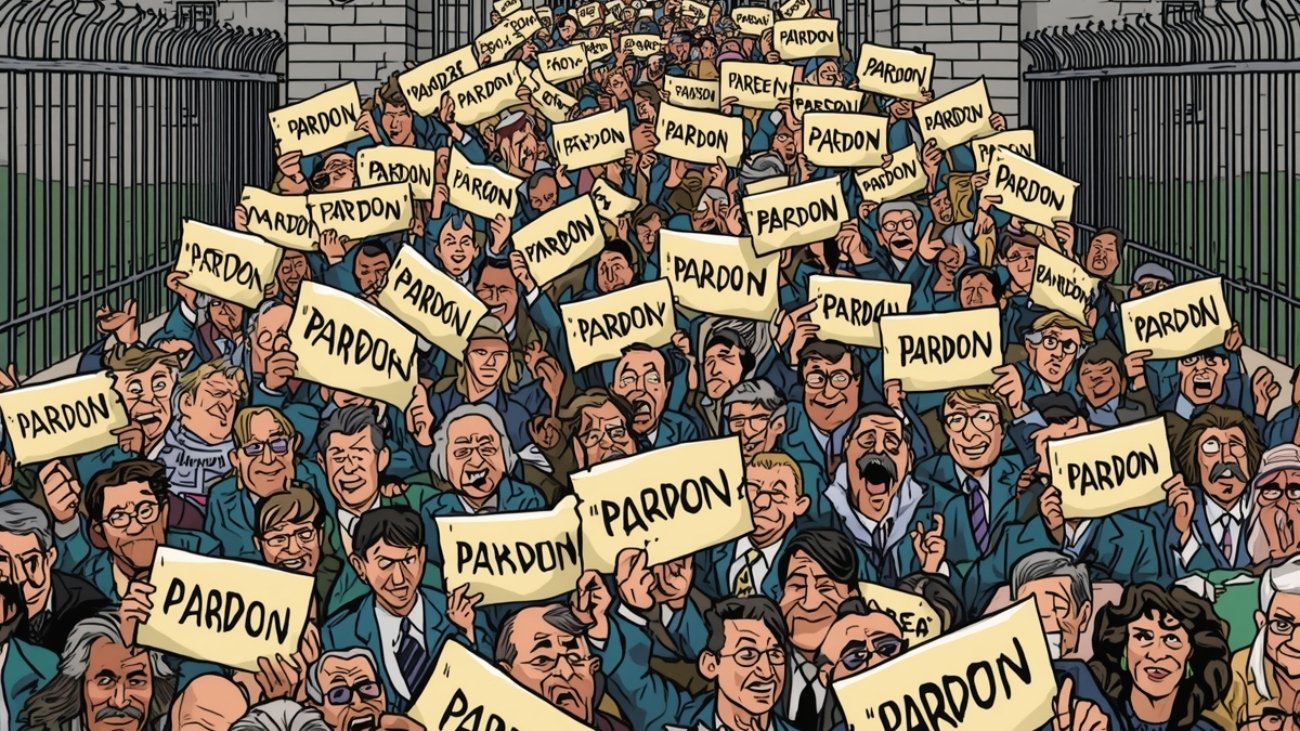
Pardon My Asking… How Can Presidents Pardon Crimes?

Pardon My Asking… How Can Presidents Pardon Crimes?

Shalzed Confronts Israeli President Isaac Herzog on Pardons and Justice

With Donald Trump pardoning allies left and right, and Israel’s President now asked to pardon the Prime Minister, Shalzed wants to know why pardons are allowed at all. Doesn’t one person having the power to erase crimes undermine justice for everyone?

Pardon My Asking… How Can Presidents Pardon Crimes?

As I walked out the door I noticed Shalzed across the street from the school where I teach, waiting at the stop where I usually catch my bus. “Surprised to see you,” I said when I walked over.

“What’s a pardon?” he asked.

A woman, leaning on the side of the bus stop shelter as she waited, looked at him funny for a moment, then frowned.

“It’s something the President can do to let someone out of jail. Are you also getting on the bus?” I asked, gesturing towards one of the long, articulated city buses waiting at a traffic light and about to pull up as soon as it changed to green.

“Donald Trump pardoned the Jan. 6th defendants, along with many of his allies and supporters. He just pardoned the President of Honduras, who was convicted of drug trafficking, even as the U.S. Navy bombs suspected drug boats. Israel’s Prime Minister just requested a pardon in order to get his corruption trial cancelled. I don’t understand. Doesn’t one person having the power to erase crimes completely undermine justice?”

“Did you just hatch from an egg or something?” the woman asked Shalzed as she shuffled towards the curb.

“It’s just the way the system works,” I told Shalzed, having never thought about it too closely. I considered saying something to the woman, but she had already stepped away and was busy fishing for coins in her purse. The bus was midway through the intersection and almost at the stop. “Are you getting on with me?” I asked Shalzed. I couldn’t imagine him taking a bus when he had his mysterious ways of transportation.

And sure enough, suddenly I felt myself floating in the dark, with points of light all around. By now this had become just a little familiar. A moment later we were in Israel, just inside the gate of Beit Hanassi, the official residence of Israel’s president, Isaac Herzog. Herzog was walking down the steps towards a waiting black car. I wondered what the woman and the bus driver saw. Did we just disappear? I decided to ask Shalzed- even though he wouldn’t tell me how he transported us, maybe he would be willing to reveal what it looks like to outsiders. But he was already striding towards Herzog.

“Can you explain to me how it’s possible for you to give someone a pardon?” Shalzed asked.

Herzog gave Shalzed a funny look. “Pardons are part of my official duties,” he said.

“So if someone is guilty of a crime, you just let them go free? How is that justice?”

A man in a dark suit, carrying a walkie-talkie and wearing a plastic earpiece in his left ear, walked over. I thought Herzog would tell him to take us away, but instead he motioned for the security guard to stop. “There are lots of reasons why pardons are necessary,” Herzog said. His face seemed thoughtful, like he was genuinely intrigued. “Pardons can actually enable justice.”

“How can that be?” Shalzed demanded, putting his hands on his hips.

To my surprise, Herzog didn’t seem phased. “The classic example is when law says something is a crime, but morality says it’s not. Like Roswell Gilbert, who was sentenced to 25 years in prison because he killed his elderly wife, who was in terrible pain and had Alzeimer’s. Even though according to the law it was first degree murder, letting him go made sense.”

“But that’s nothing like what’s going on today in Israel and the U.S.,” Shalzed said.

The security guard looked at us. “How did you two get in here?” he asked. His English seemed okay, but he rolled the final ‘r’ like a true Israeli.

“Sometimes pardons are for the simple reason that prisons are overcrowded,” Herzog continued. “If there isn’t room to hold people, causing a violation of prisoners’ rights, then the humane thing to do is release some who are non-violent or close to the end of their sentence.”

The guy sitting in the driver’s seat started the black car, and the security guard near us looked at Herzog and pointed towards the gate. “Ozvim,” I said to the guard, meaning we were leaving. I hoped he would be reassured if he saw I spoke a little Hebrew.

“But letting people out of prison because there isn’t enough space is still a failure of justice,” Shalzed said.

“True,” Herzog replied. “But it can be the lesser of two evils. Another reason for pardons is they may be the only way to restore peace. Like when U.S. President Andrew Johnson pardoned all the Confederates who were guilty of treason after the Civil War. Or when Ford pardoned Nixon for Watergate.”

“And Israel just pardoned many convicted terrorists in order to secure the release of hostages,” I added, thinking that might be too delicate a matter for Herzog to bring up.

“Why should terrorists be exchanged for innocent hostages?” Shalzed asked, raising his palms.

Herzog shook his head, and I looked down. “I’m sorry, I’m on the way to New York,” Herzog told us. “I’m getting an honorary degree from Yeshiva University tomorrow.” He took another step towards the car as the security guard smiled.

“Isn’t one person having all this power prone to being abused?” Shalzed asked. “Why should Trump be allowed to grant pardons to his allies and donors?”

“He claims their prosecution was politically motivated,” Herzog said

“So that’s what Bibi says too,” I added.

Herzog gave me a look like I had said the very words which must not be uttered. The guard took a step towards me.

“But if prosecution was politically motivated, shouldn’t there be another trial, or impartial panel, to make that decision? How can it be up to the President? Pardons are obviously politically motivated too.”

“There is a process,” Herzog said. “For example, in Bibi’s case right now everything is being reviewed by Israel’s department of justice.”

“Holchim,” the guard said, putting an arm on Herzog’s shoulder, tugging him gently towards the car.

“So are you going to pardon Bibi?” I asked. I figured he probably wouldn’t answer, but it was worth a shot.

“As I make my decision, I will consider only the good of the country,” he said. “If you have an opinion you can send it via my official website.”

Herzog got into the car and it pulled out into the street. The guard held the gate open, staring at us.

“Todah,” I told him, nudging Shalzed to follow me out. As soon as the gate had closed behind us and locked securely, he got into the car. It sped away with its lights flashing. An Egged bus stopped next to where we were standing and some American tourists, speaking English and holding maps of Jerusalem, got out.

“How does Herzog expect people to believe his decision whether or not to pardon Bibi is solely for the good of the country?” Shalzed asked me. “There could be some political tradeoff, or other deal.”

I shrugged. “At least in the United States, there are suggestions for reform. One Congressman proposed a constitutional amendment to prohibit the President from pardoning himself, his family, campaign members, or administration officials. A senator introduced a bill to require the president to make public all documents related to pardons so there can at least be oversight.”

“Selicha,” a woman who had just gotten off the bus said to me. “Do you speak English?” I nodded. “We are looking for Beit Hanassi.”

“Right here,” I said, gesturing towards the stone compound behind us. “But you missed Isaac Herzog- he just left for New York.”

“Do you know if there is any way for us to take a tour?” the woman asked me.

“Ask him,” I said, pointing to Shalzed. “He knows how to get past the gate.”

The woman looked at Shalzed for a moment, considering. “Did you just take the tour?” she asked.

I was curious what Shalzed would say, but suddenly I was back in the black passage again. I looked at the lights trying to figure out whether or not I was moving, then a moment later Shalzed and I were outside the apartment building where I lived.

“But how. . .” I began.

“Sorry, I can’t explain,” Shalzed said.

“But that woman. And the bus driver. What did they see? What do they think happened?” I asked.

Shalzed shrugged. “Don’t worry, they’ll be fine.”

“Why won’t you tell me? For all the help I give you, I think I at least deserve some information.”

“I kindly suggest you stop asking,” Shalzed said firmly.

I swallowed. “Fine. Pardon me.”

He smiled. “Not without some sort of transparent process.”

I laughed and started up the stairs.

Subscribe to Receive Shalzed's adventures in your inbox

Discussion Questions:

  1. Is the benefit of pardons as a sometimes necessary check on the criminal justice system outweighed by their potential for abuse?
  2. Right now in both Israel and the U.S. pardon power is exclusively in the hands of the President. Should that be changed to require public input, committee deliberation and so forth? Or would that make the process too slow and cumbersome, such as when Israel needed to free prisoners to secure the release of hostages?
  3. How should Israeli President Isaac Herzog go about determining if Bibi’s pardon request is ‘in the interests of the nation’. What, exactly, does that even mean?

Sources:

For an overview of legal issues concerning pardons in the U.S. from the Bar Association click here.

For an international overview of how pardons work in various countries around the world from the International Law Blog click here.

shalzed watches drug boat two

War on Crime: Just Murder or Justice?

War on Crime: Just Murder or Justice?

Was Trump’s decision to declare war on cartels a resourceful tactic or a frightening switch?

shalzed watches drug boat two

War is a temporary legal situation in which the prohibitions of murder and destruction are lifted. Ordinarily it is against the law to kill people- but should war be declared, for the duration of the conflict soldiers may kill one another. As long as they do so in accordance with the laws of armed combat they’ll face no legal repercussions at all.

Declaring war is therefore an extraordinary power, so much so one might wonder how on Earth anyone can possibly be able to do it (on my planet such a thing can’t be done!). But simply as a matter of custom, we accept it as given that governments can in fact declare war and thereby permit murder, arson, and so forth for limited periods of time.

Bringing drugs to the U.S. for sale is a crime. According to Article 11 of the Universal Declaration of Human Rights, anyone suspected of a crime has the right to a presumption of innocence and a fair trial.  Therefore, common practice has always been that should a boat be suspected of smuggling drugs to the U.S., the Coast Guard intercepts it to search for evidence. If evidence is found, those on board are arrested and put on trial. The Coast Guard may only use force in self-defense or if the boat attempts to flee.

However, the U.S. military has recently begun bombing such boats with no warning and killing everyone on board. While this would at first appear to be a gross violation of human rights, President Trump justified this by determining that the U.S. is now at war. Therefore, with regard to these boats murder and destruction are allowed. He has not made clear exactly what gangs or cartels the U.S. is at war with, or how the U.S. military decides if a given boat is connected to those entities.

As a mater of domestic law, it is questionable whether the president can do this without the approval of Congress. But be that as it may, is this a proper use of war?

Trump may argue that drug smugglers abuse their rights in order to enable themselves to commit their crimes. They find ways to destroy contraband before being caught and know how hard it is to construct a legal case against them. And they exploit the vastness of the ocean and the limits on the Coast Guard’s use of force to evade detection, and should they be detected to escape. Illegal drugs cause countless harms, including numerous overdose deaths, and the government has to find a way to stop these drugs from entering the country. Declaring war to enable bombing the boats may be the only way.

But there are many reasons to worry. If the government can declare war other than when it is confronted with an organized enemy carrying out armed attacks, where will it end? Could this war be extended from drug smugglers on the high seas to drug dealers on U.S. soil? Could war be declared against other types of criminals as well? What about migrants illegally crossing the border? Could war on political opponents be next?

Is expanding the definition of war a good way to address problems that have no other, easier solution? Or do we need to constrain the right to declare war as much as possible, due to the immense harm, including harm to innocent people, a declaration of war may lead to? I’m curious to hear your thoughts.